


Identifier
MDA.MUS.00007.2
Support
Structure
Title
Cave The Great Acceleration
Caverna A Grande Aceleração
Caverna A Grande Aceleração
Group
Description
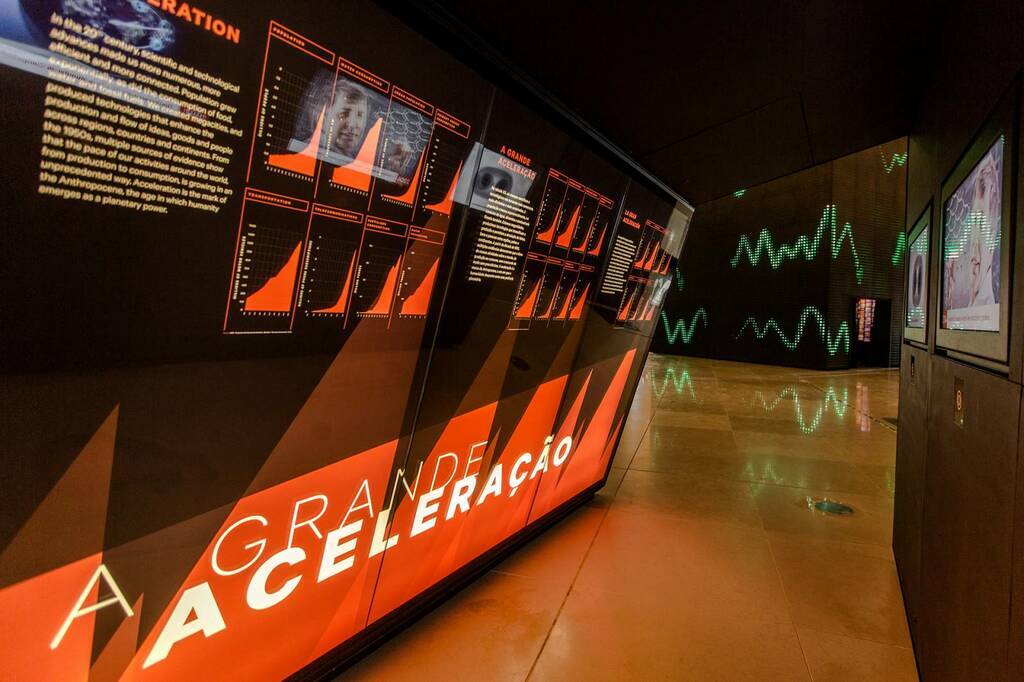
The cave, located at the first totem on the right side of the Anthropocene area, is dedicated to the theme of the Great Acceleration—a period that began in the 1950s, characterized by the rapid growth of production and consumption on a global scale. The content highlights how this unsustainable economic model has caused climate change, biodiversity loss, pollution, and environmental degradation.
To limit global warming to 1.5°C, it would be necessary to reduce greenhouse gas emissions at a rate 25 times faster than the current rate. The material shows that the excessive use of natural resources already exceeds the planet's regenerative capacity and warns that, without structural changes, the sustainability of present and future generations will be seriously threatened.
The texts related to the content of the Great Acceleration Cave can be found in the Additional Information > Text section.
Caverna localizada no primeiro totem, no lado direito da área do Antropoceno, dedicada ao tema Grande Aceleração — período iniciado na década de 1950, caracterizado pelo rápido crescimento da produção e do consumo em escala global. O conteúdo destaca como esse modelo econômico insustentável tem provocado mudanças climáticas, perda de biodiversidade, poluição e degradação ambiental. Para limitar o aquecimento global a 1,5 °C, seria necessária uma redução das emissões de gases de efeito estufa em um ritmo 25 vezes mais rápido do que o atual. O material evidencia que o uso excessivo dos recursos naturais já ultrapassa a capacidade de regeneração do planeta e alerta que, sem mudanças estruturais, a sustentabilidade das gerações presentes e futuras estará seriamente ameaçada. Os textos relacionados aos conteúdos da Caverna A Grande Aceleração encontram-se no campo Demais informações > Texto.
Caverna localizada no primeiro totem, no lado direito da área do Antropoceno, dedicada ao tema Grande Aceleração — período iniciado na década de 1950, caracterizado pelo rápido crescimento da produção e do consumo em escala global. O conteúdo destaca como esse modelo econômico insustentável tem provocado mudanças climáticas, perda de biodiversidade, poluição e degradação ambiental. Para limitar o aquecimento global a 1,5 °C, seria necessária uma redução das emissões de gases de efeito estufa em um ritmo 25 vezes mais rápido do que o atual. O material evidencia que o uso excessivo dos recursos naturais já ultrapassa a capacidade de regeneração do planeta e alerta que, sem mudanças estruturais, a sustentabilidade das gerações presentes e futuras estará seriamente ameaçada. Os textos relacionados aos conteúdos da Caverna A Grande Aceleração encontram-se no campo Demais informações > Texto.
Collection
Author
Co-author
Caption
Antropoceno: A Grande Aceleração. 2015. Técnica mista. 228 x 289 x 186 cm | Duração variável.
.
Anthropocene: The Great Acceleration. 2015. Mixed media. 228 x 289 x 186 cm | Variable duration.
.
Antropoceno: La Gran Aceleración. 2015. Técnica mixta. 228 x 289 x 186 cm | Duración variable.
Accessibility
Brazilian Sign Language (Libras)Accessibility
Virtual tourAccessibility
Additional Type
Technique
PrintingTechnique
Assembly | MountingTechnique
Electrostatic paintingTechnique
Screen printingTechnique
Mixed mediaTechnique
Material
Metal sheetMaterial
ComputerMaterial
CPU (Central Processing Unit)Material
Thermal and acoustic insulationMaterial
Video monitor (LED)Material
Multi-touch monitor (LED)Material
MP4 (MPEG-4 Part 14)Material
Orthophonic tissueMaterial
Epoxy paintMaterial
Cooler FanMaterial
Tempered glassMaterial
Size
228 x 289 x 186 cm
fileExtension
resolution
variável
fileSize
variável
duration
variável
language
researcher
Exhibition
Related Item6
Text
Great acceleration
The increase in production and consumption levels in all the planet, from the 1950's on, has made this period known as Great Acceleration. A time when the economic development model becomes unsustainable, causing climate change, loss of biodiversity, ocean acidification, soil degradation, and a serious problem with pollution. Today, for example, around 2 billion tons of garbage are produced worldwide.
In order to reach the goal of maintaining the increase in the average temperature of the planet at 1.5 °C, as defined in the Paris Agreement in 2015, it is necessary to drastically reduce the volume of greenhouse gas emissions. The carbon intensity of the industrial sector and the burning of fossil fuels has decreased by 0.3% per year in the last decade, but for the agreement to be reached, this reduction would need to be 7.7% per year, that is, 25 times greater.
If we continue with the current development model, the planet will be unable to sustain the livelihoods of current and future generations. In 2022, for example, humanity consumed, in the month of July, the resources that nature is able to offer in one year.
INFOGRAPHICS:
GREAT ACCELERATION
Projected waste generation, by region (millions of tonnes/year)
Millions of tonnes per year
Global waste composition
Food and green; Glass; Metal; Other; Paper and cardboard; Plastic; Rubber and leather; Wood
Grande aceleração
O aumento dos níveis de produção e consumo em todo o planeta, a partir da década de 1950, tornaram este período conhecido como a Grande Aceleração. Uma época em que o modelo de desenvolvimento econômico se torna insustentável, provocando mudanças no clima, perda de biodiversidade, acidificação dos oceanos, degradação do solo, além de um grave problema com a poluição. Hoje, por exemplo, são produzidas cerca de 2 bilhões de toneladas de lixo em todo o mundo.
Para atingir a meta de manter o aumento da temperatura média do planeta em 1,5 °C, como definido no Acordo de Paris em 2015, é preciso diminuir drasticamente o volume de emissões de gases de efeito estufa. A intensidade de carbono do setor industrial e da queima de combustíveis fósseis diminuiu 0,3% por ano na última década, mas para que o acordo seja atingido, essa redução precisaria ser de 7,7% por ano, ou seja, 25 vezes maior.
Se continuarmos com o modelo de desenvolvimento atual, o planeta será incapaz de sustentar os meios de subsistência das gerações atuais e futuras. Em 2022, por exemplo, a humanidade consumiu, no mês de julho, os recursos que a natureza é capaz de oferecer em um ano.
INFOGRÁFICOS:
GRANDE ACELERAÇÃO
Geração de resíduos estimada por região (milhões de toneladas/ano)
Milhões de toneladas por ano
Composição global dos resíduos
Orgânico; Vidro; Metal; Outros; Papel e papelão; Plástico; Borracha e couro; Madeira
Keyword
ConsumptionThing
Main ExhibitionThing
Energy SourcesThing
Possible HorizonsThing
HumanityThing
PollutionThing
Environmental RacismThing
SocietyThing
Climate EmergencyThing
Video3
Audio