
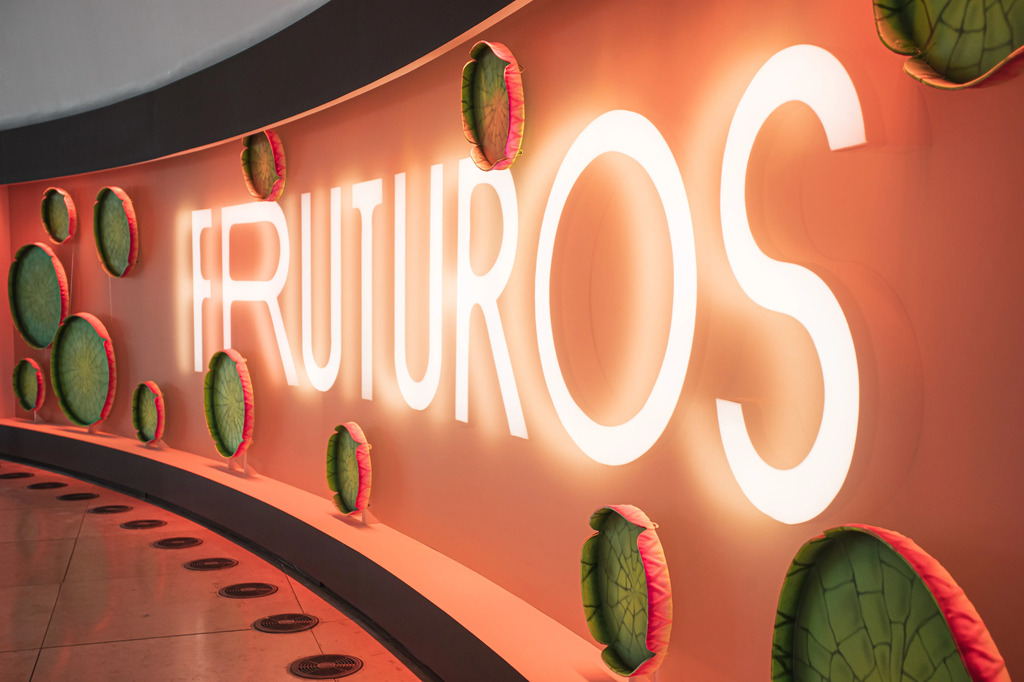
Visitors to the new temporary exhibition at the Museum of Tomorrow, Fruturos - Tempos Amazônicos, which began development in 2017, are surprised by a narrative about the biological and social complexity of the world's largest biome, the Amazon.
Behind the scenes, ten scientists participated in developing the exhibition's content. Led by one of the world's leading experts on climate change, Paulo Artaxo, who is the chief consultant for Fruturos, the specialists wrote articles that guarantee the credibility and advanced state of knowledge of the information displayed in wall texts, interactive exhibits, games, and all other experiences offered to the public.
"Present in eight countries and occupying almost half of Brazil's territory, the Amazon currently shelters more than 30 million people, including different traditional peoples, thousands of plant species, and is one of the most biodiverse regions on the planet. Important for Brazil and the world, the consultants who participated in the development of Fruturos are fundamental to the quality of the information we have already brought to more than 70,000 people in less than three months," explains Leonardo Menezes, Director of Knowledge and Creation at the Museum of Tomorrow.
The exhibition brings to the public knowledge from the natural and social sciences about the Amazon.
Across seven areas, the exhibition presents the grandeur, biodiversity, and knowledge present in the world's largest tropical biome, proposes new discoveries about the relationship between the forest and the climate, and highlights the urgent need for its conservation.
To address these themes, it was extremely important to have consultants from the region, such as Rita Mesquita, who is dedicated to scientific dissemination, rural extension, and the popularization of science at the Extension Coordination of the National Institute for Amazonian Research (INPA). Dialogue with different research centers allowed the Museum of Tomorrow to learn even more about aspects of the biome.
In "Ancient Amazon," for example, Marina Kahn, president of the Institute for Indigenous Research and Training (Iepé), provided in-depth information on the history of indigenous population occupation in the region, their relationship with nature and cultural diversity, as well as their challenges and the struggle for the demarcation of their lands. In "Secular Amazon," Professor and researcher Francisco de Assis, from the Center for Advanced Amazonian Studies (Naea) at the Federal University of Pará (UFPA), shared various information and data on the economy of traditional populations, who have a significant presence and importance for the development of the Amazon, due to their income growth being coupled with low environmental impact.
The "Accelerated Amazon" area featured the support of three consultants. Scientist and chief consultant Paulo Artaxo explained how the Amazon and the global climate influence each other, the temperature increase in the biome caused by climate change, the changes and alterations in the region, and its climatic future. Ecologist and researcher at the Goeldi Museum, Ima Vieira, provided details on conservation, deforestation, environmental degradation, wildfires and fires, and the resilience of the Amazon rainforest. Ecologist Paulo Moutinho, co-founder of the Amazon Environmental Research Institute (IPAM), complemented this with the value the forest holds for the planet, the threats it faces, the reasons for its destruction and its consequences, and what can be done to reverse this situation.
Finally, in "Possible Amazons," economist and Senior Professor of the Environmental Science Program at IEE/USP, Ricardo Abramovay, and Nurit Bensusan, researcher at the Socio-Environmental Institute (ISA), highlighted the effects of deforestation on climate change and agriculture, and sustainable development. Professor Fabio Scarano, an ecology professor at the Federal University of Rio de Janeiro (UFRJ), and Anna Carolina Aguiar, a biologist and postdoctoral researcher at the Limnology Laboratory of the Federal University of Rio de Janeiro (UFRJ), discussed the context of the Amazon within the world's tropical forests and the diversity of ecosystems, species, and genes present in the biome, as well as economic issues and the lesson that the world's largest forest leaves for everyone.
About the exhibition
Fruturos - Amazonian Times is a project of the Museum of Tomorrow, managed by the Institute for Development and Management and carried out by the City Hall of Rio. Presented by the Vale Cultural Institute, through the Law of Incentive to Culture, the exhibition has partnerships with IPAM, AFP, Globo, and Agência Sapiens. Learn more!