
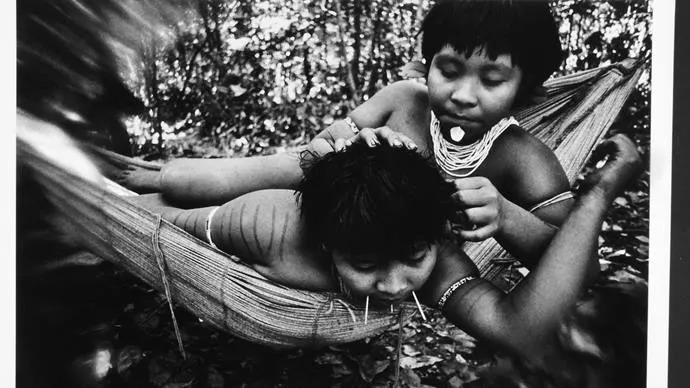
Photograph "Two girls in a hammock", 1970, by Claudia Andujar. Credits: Curitiba City Photography Museum.
We have extremely dynamic and hectic routines. Reducing sleep time is generally a common practice when we think about "saving" time for other daily commitments or personal tasks.
Taking advantage of long commutes on public transport to take a nap, yawning sleepily all day, and accumulating fatigue throughout the week are more common than they should be. We end up getting used to these (not so) small sacrifices to meet the most varied demands.
Although connected to the act of sleeping, when we talk about dreams—or the act of dreaming—the possibilities are many.
We can dream while sleeping, but we also dream while awake. Generally, the dreams we have while awake are the personal goals we pursue throughout our lives and require action to become reality—in the short, medium, or long term.
Dreaming, sometimes, is not so simple, unfortunately; Whether due to a lack of free waking time or insufficient sleep, dreaming ends up being impaired, and this also affects how we imagine and conceive the present and the future.
If our dreams are neglected (by ourselves, other people, or decision-makers), at some point they simply become a wish that will not necessarily come true.
Finding free time in a busy routine or sleeping longer might be your dream. Here, I invite you to appreciate and expand on the idea of it and connect this act with the past, present, future, and the Yanomami people.
I will present one of the Yanomami perspectives, a geographically large indigenous population living between the Northern region of Brazil and Venezuela¹,².
In community tales, Omama is the creator of the Yanomami people, and his son is the first shaman responsible for protecting the Yanomami on earth.
For the Yanomami, shamans are the spiritual protectors of the community, the people designated to access and connect the visible world (the world we experience while awake and/or alive) to the non-invisible world (the world we experience while sleeping or when we are no longer alive) through rituals.
The act of dreaming while sleeping is of great importance in the collective daily decisions of the community, since, for them, dreams are real experiences³. Sharing and interpreting such dreams is a common practice and can even influence the tasks that will or will not be performed for the rest of the day, depending on the content of the dream.
When we think about our way of conceiving and living in the world, it is difficult to give such a crucial role to our dreams. Especially if we consider those that occur while we sleep.
In our society, we do not have the figure of the shaman connecting worlds and interpreting dreams, and the dreams that interfere in our lives are generally those we have while awake, our personal life goals.
Thinking about these goals, the issue can become even more complex, since they are common desires for many people, but conceived individually, without social sharing. A common example: buying/financing one's own home. Buying it involves having money, but before that, individually, the person needs to be employed to get the money. It also involves that this person being capable of doing the work, that is, in good physical and mental health to perform such activity. They need to eat, move around to different places, and have time to acquire the desired house.
The house is an individual achievement, or a group achievement (family, friends, relatives, etc.), but indirectly, to achieve it we need other people and other dreams (since each person has one or more dreams in common), can you see that? Buying a house, even if it's for a single family, in this line of thinking can be a collective future dream! Collective in the sense of being dreamed together, in sync with many other people who aspire to the same thing, and we often don't realize it!
The beauty of this idea lies in the fact that, in society, many futures and dreams can coexist, just as they already do in our present and have done in the past. Each being is unique, whether genetically or in their pursuit of a dream.
However, unlike the Yanomami, we don't collectively reflect on dreams, and this makes it difficult to imagine the different futures that are dreamed of in our society. Generally, when we think about the future, we have difficulty visualizing peaceful, pleasant, and harmonious scenarios. And even more difficulty in thinking about other living beings besides ourselves, human beings, ourselves, or our families.
The experience of indigenous populations with their dreams (in this text, the example of a Yanomami community) can be one of several possibilities for change in the pursuit of futures—in the plural—that are dreamed, shared, and lived by different people. Futures can be built from the sharing of dreams, whether those we have while sleeping or those we have while awake.
Decision-making, whether at home, at work, or in the government of a country, for example, should be based on broad conversation where various people are heard and considered in their journeys. Not only heard, but welcomed in the construction of futures, where their life-goal dreams, such as the long-awaited house, are not just another individual dream, but have importance in the collective directions to be decided.
Let's take Ailton Krenak as a proposer of dreams. As the first indigenous person to occupy a seat in the 127-year history of the Brazilian Academy of Letters, he brings with him and promises to: “promote a symphony. Estimated by linguists to encompass 180 indigenous languages.”
This in the month that celebrates the struggle of the indigenous peoples of Brazil (April 19th).