
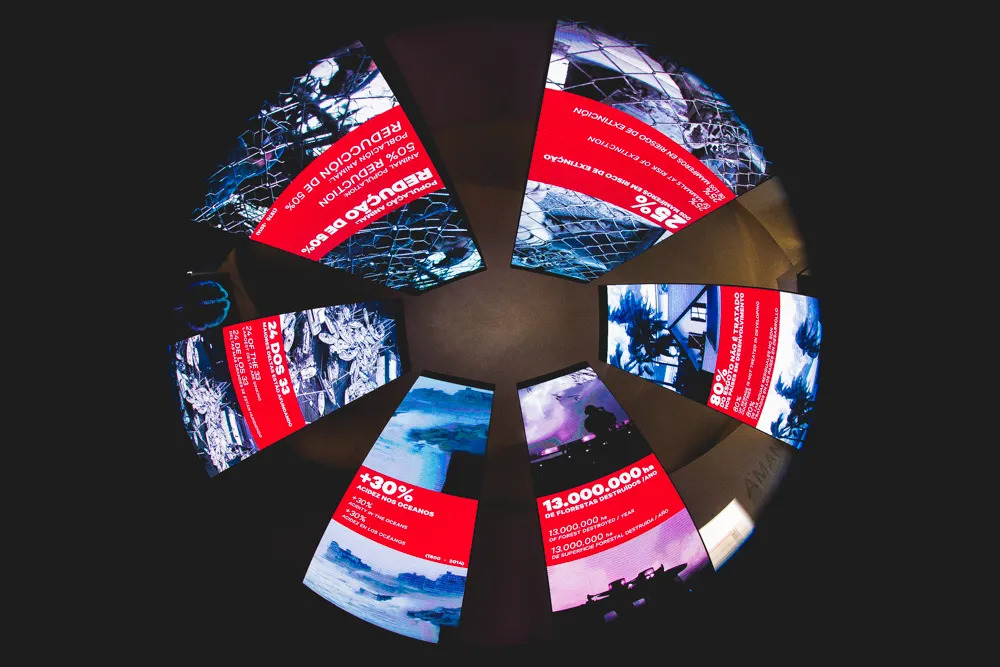
Museum of Tomorrow: Anthropocene. Photograph by David Argentino.
3.6 billion people are already suffering the consequences of climate change worldwide, primarily the most vulnerable populations and ecosystems. This warning was issued by the IPCC, the Intergovernmental Panel on Climate Change, in the second volume of its Sixth Assessment Report (AR6). Released in February of this year, approximately 270 researchers from nearly 70 countries participated in the preparation of the document, which also states that the planet will likely reach or exceed the 1.5°C warming target proposed by the Paris Agreement in the next two decades.
That's not all. In April, the IPCC also released the third and final volume before the synthesis report, which will be released in September and consolidates information from all studies produced throughout the AR6 cycle. Bringing together more than 260 researchers from 65 countries, the study warned that if global governance maintains current climate policies, the Earth will warm by 3.2°C by the end of the century, more than double the Paris Agreement limit. To address this scenario, the financial resources allocated to emissions reduction need to be six times greater than they are today. And when considering the costs of these adaptation measures, cutting emissions does not significantly impact global GDP. The world's GDP is expected to double by 2050, while the mitigation measures adopted from now until 2025 would produce a reduction of 0.04 to 0.09 percentage points per year in global wealth.
“The ongoing research work of the Observatory of Tomorrow, based on reports released by the IPCC, provides visitors to the Museum of Tomorrow with the most up-to-date information on the effects of climate change already being experienced across the planet, as well as actions to address them, whether through mitigation or adaptation to their effects,” explains Davi Bonela, scientific development manager of the museum. “With the new IPCC report, the museum has already made more than 60 updates to its Long-Term Exhibition in the last six months on what is one of the greatest global challenges of our time,” he concludes. The Observatory of Tomorrow is presented by Shell.
Rising average global temperature is already causing species extinctions
According to the second AR6 report, climate change has also caused losses of endemic species, increased disease, mass die-offs of plants and animals, restructuring of ecosystems, increased areas burned by forest fires, and declines in key ecosystem services. This is causing economic losses and altering cultural practices and recreational activities worldwide.
Furthermore, climate change is negatively affecting the physical and mental health of people around the world. The occurrence of foodborne and waterborne diseases related to climate is increasing, as is the incidence of vector-borne diseases. Cardiovascular and respiratory problems have also been associated with increased exposure to smoke from fires. Forests. Furthermore, some mental health challenges, trauma resulting from climate events, and the loss of livelihoods and culture are linked to rising temperatures. Healthcare services, which are designed to protect individuals from these effects, are being disrupted by extreme events such as floods. If humanity continues on this path, more than 9 million climate-related deaths per year are projected by the end of the century, under a scenario of high greenhouse gas emissions.
Half of CO2 emissions have occurred in the last 30 years and continue to increase.
According to the report, from the Industrial Revolution in 1750 to the present day, humanity has emitted 2.4 trillion tons of CO2, with 48% of these emissions released into the air since 1990 and 17% released into the air in the last decade alone. There is a huge regional and social disparity in emissions: the world's poorest countries and island nations, the main victims of climate impacts, together contributed less than 4% of global emissions in [year missing]. 2019.
For humanity to stabilize at least 50% of global warming within the 1.5°C limit recommended by the Paris Agreement, global greenhouse gas emissions need to peak between 2020 and 2025 and fall by 43% by 2030. However, in 2019, for example, these emissions were 59 billion tons, a value 12% higher than in 2010 and 54% higher than in 1990.
Brazil in the IPCC report
The impact of climate change is also being felt, and will continue to be felt, in Brazil. According to the IPCC report, the incidence of extreme droughts in the Amazon is expected to increase the costs of treating respiratory diseases by 20% to 50%, and the incidence of malaria by 5% to 10% by 2030, implying a high cost of living, as people will be prevented from earning their livelihoods. These extreme droughts are also expected to accelerate and intensify the migration of traditional communities and indigenous peoples to urban centers, where their quality of life is likely to decrease as they occupy vulnerable areas.
National biodiversity is also seriously threatened. Still in the Amazon, deforestation to clear agricultural land is the main cause of the decrease in the number of trees, reducing forest cover by an average of 13,900 km² per year between 1988 and 2020.
However, the severity of the effects of climate change in Brazil can still be reduced according to future choices. In 2014, indigenous territories and other protected areas accounted for the equivalent of 58.5% of all carbon stored in the Amazon rainforest and had the lowest rate of deforestation (2.1%) and incidence of fires, demonstrating the effectiveness of traditional knowledge in safeguarding important ecosystem services. It is estimated that indigenous territories contribute at least US$5 billion per year to the global economy through food and energy production, offsetting greenhouse gas emissions, and climate regulation and stability.useum of Tomorrow: Anthropocene. Photograph by David Argentino.