
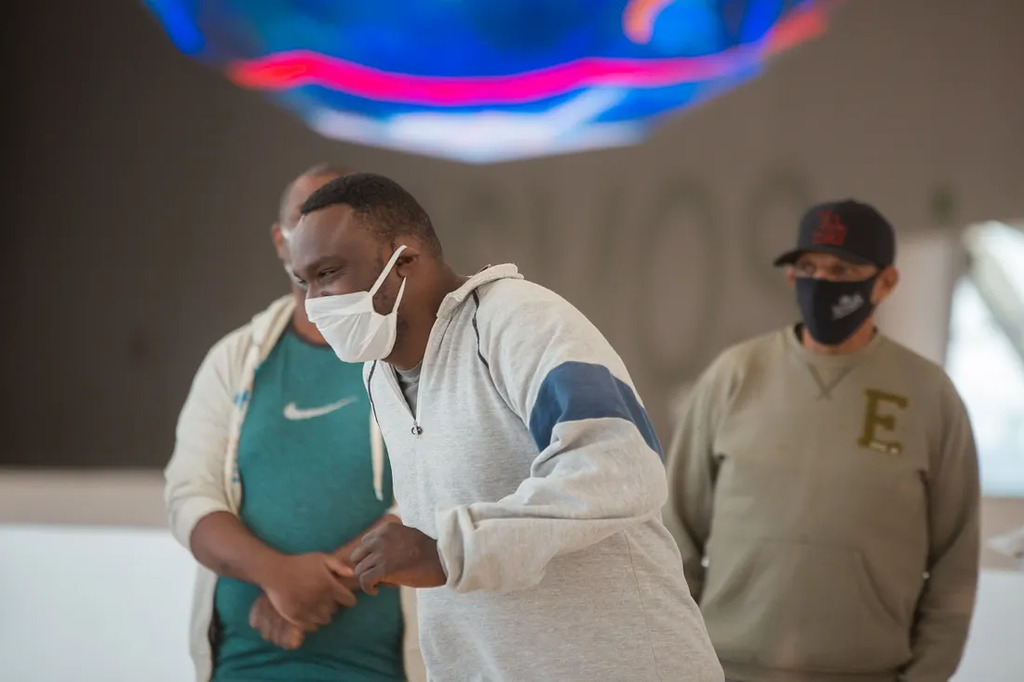
Visitors and sphere in the background. Photograph: Museum of Tomorrow.
"Every human being, as a member of society, has the right to social security and is entitled to realization, through national effort and international co-operation and in accordance with the organization and resources of each State, of the economic, social and cultural rights indispensable for his dignity and the free development of his personality."
The above excerpt is taken from Article 22 of the Universal Declaration of Human Rights, declared and proclaimed on December 10, 1948, which this year celebrates its 73rd anniversary. It is worrying that, even after seven decades, we are still moving slowly towards guaranteeing basic rights for human dignity; entire populations still suffer discrimination because of their race, gender, nationality, or economic status. Discussing the importance of Human Rights is urgent in the current context.
In this sense, museums, in addition to providing leisure, have a crucial role in shaping the conscience of the community in which they are located, bringing these discussions to the local context and implementing internal policies that recognize racial, social, and gender exclusion. Museums are spaces of collective memory, and recognizing the untold history of groups excluded from official narratives is to truly understand the history of the society in which we live and what still needs to be improved to accelerate the path to equality. It is their role, as well as that of other cultural institutions, to bring about social transformations in the communities to which they belong.
The exhibition Fruturos — Tempos Amazônicos arrives at the Museum of Tomorrow on December 17th, showcasing the grandeur, biodiversity, and social and cultural diversity of the biome through an immersive environment. The intention is to present to the museum's audience the different configurations within the Amazon, proposing a development model based on science, traditional knowledge, and forest conservation.
Far beyond aesthetic appeal, *Fruturos* aims to bring to the Museum of Tomorrow's audience discussions about the biome and the impact of transformations caused by rampant exploitation in a playful and simplified way, stimulating reflections on sustainable development. There is no tomorrow without recognizing and preserving the traditional knowledge of the peoples who were here before colonization. More than ever, we need to acknowledge and care for this heritage before it's too late.