Uncertainty marks the perception of the future, according to research conducted by the Museum of Tomorrow during the coronavirus pandemic.
24/07/2020
Author
Thematic Axis
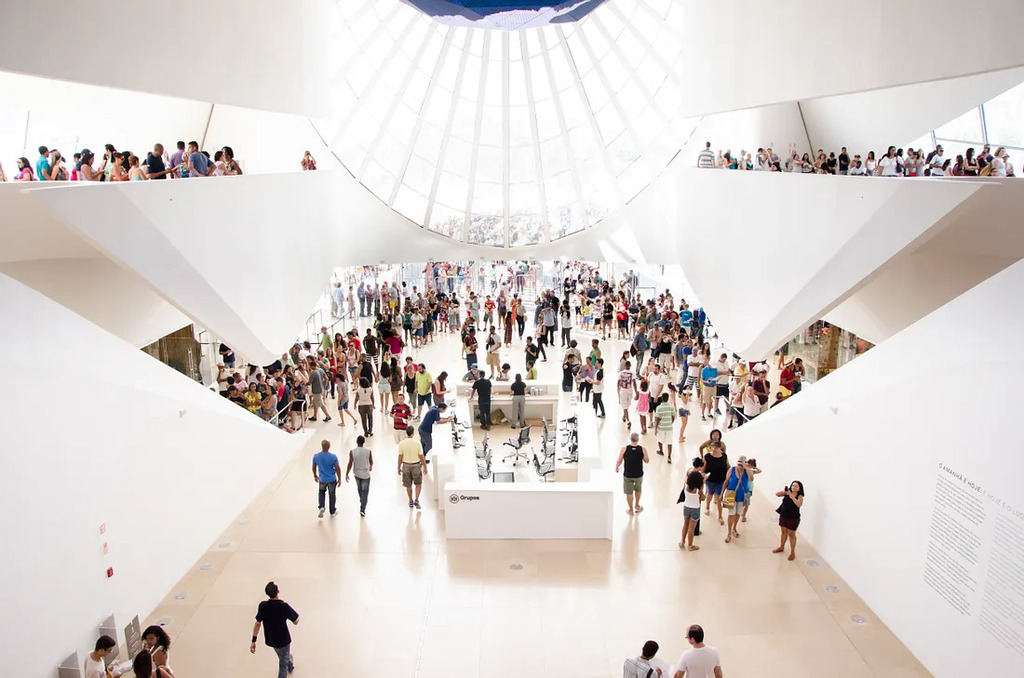
Atrium of the Museum of Tomorrow, in Rio de Janeiro, before the pandemic. Photograph: Byron Prujansky.
For over a thousand people across the country, the greatest hope is that the pandemic will serve as a lesson for building a more just world; the greatest fear is that new pandemics will occur.
The Museum of Tomorrow conducted a survey on its audience's perception of the future following the COVID-19 pandemic. More than a thousand people from across the country reflected on people's lives, society, and the environment up to the next decade.
“The pandemic has altered the routine and way of life of billions of people around the world. This research shows that it has brought fears and uncertainties, but also hopes due to its pedagogical character, capable of providing important lessons and learnings from this difficult period,” commented Alfredo Tolmasquim, Director of Scientific Development and Education at the Museum of Tomorrow.
The pandemic causes much uncertainty about the future, especially among women and young people.
According to the survey, 93% of the museum's audience feels informed about the COVID-19 pandemic. Among them, 18% feel excessively informed. The main consequence of this information overload is anxiety.
Participants said they primarily get their information from traditional media (71%). Other frequently cited sources of information include digital communicators specializing in health or science (48%), international official bodies (46%), and national official bodies (42%).
Although these are sources of information that verify the reported data, the research shows that the COVID-19 pandemic has profoundly impacted people's level of certainty about the future. In total, two out of three respondents say that even with this information, they have a great deal of uncertainty about the future. The data shows that the people who feel most uncertain about the future are those who said they were under-informed or over-informed.
Women feel more uncertain about the future than men. 44% of women acknowledge feeling very uncertain, while among men this percentage is 25%. Among those who indicate uncertainty about the future following the pandemic, young people aged 16 to 24 stand out, with 77% reporting uncertainty.
There is also a significant difference in optimism about the future between men and women. While 24% of women say they are optimistic about the future, this percentage is 42% for men.
Hope for a more just world, fear of new pandemics
The research also addressed the public's fears and hopes stemming from the pandemic. 95% of respondents said that the pandemic caused at least one fear about the future. The main fear is that new viruses and pandemics will become frequent. However, the most significant fear is that this pandemic will not bring about any change in society. Other fears mentioned include mass unemployment, economic crises, and the intensification of social inequalities.
The main hope for the future mentioned by those interviewed is that this period will raise awareness among various sectors of society and be used as a learning experience, enabling reflections that contribute to building a more just world. Other hopes cited were the strengthening of solidarity habits and bonds of coexistence and unity among human beings, and the appreciation of science and technology.
Reducing inequalities should be a priority for governments and society until 2030.
The survey participants also gave their opinion on which challenges represented by the Sustainable Development Goals should be a priority for governments and society until 2030. For the public, the main social priority should be the reduction of social and economic inequalities (69%), followed by the provision of quality education for all (65%) and also health and well-being for all (59%). Despite this, when questioned about changes for the next 10 years, 69% of survey participants do not expect that the reduction of inequalities will actually happen by the beginning of the next decade.
The three challenges that should be prioritized by governments and society regarding the environment by 2030 were clean water and sanitation for all (64%), conservation and sustainable use of forests and other terrestrial biomes (56%), and sustainable production and consumption (39%). Expectations regarding the improvement of these challenges by 2030 indicate that only in the challenges of sustainable production and consumption and clean and affordable energy for all is there a majority that believes we will be closer to their solution in 2030, percentages of 53% and 50.2%, respectively. In the case of clean water and sanitation for all, only 43% believe that we will see any improvement over the next 10 years.
Pandemic and Vision for the Future
The research was conducted by the Museum of Tomorrow in May and June 2020 with the aim of analyzing the Museum of Tomorrow's audience's perception of the future in light of the new coronavirus pandemic, encouraging participants to reflect on themes related to people's lives, society, and the environment connected to the Sustainable Development Goals. Qualitative and quantitative in nature, it consisted of 40 open or closed questions, sent to the Museum's audience via email and available for response through the Typeform digital platform. Due to public participation, the margin of error for the research is 3%. The study was developed by the Research Coordination of the Museum of Tomorrow.