
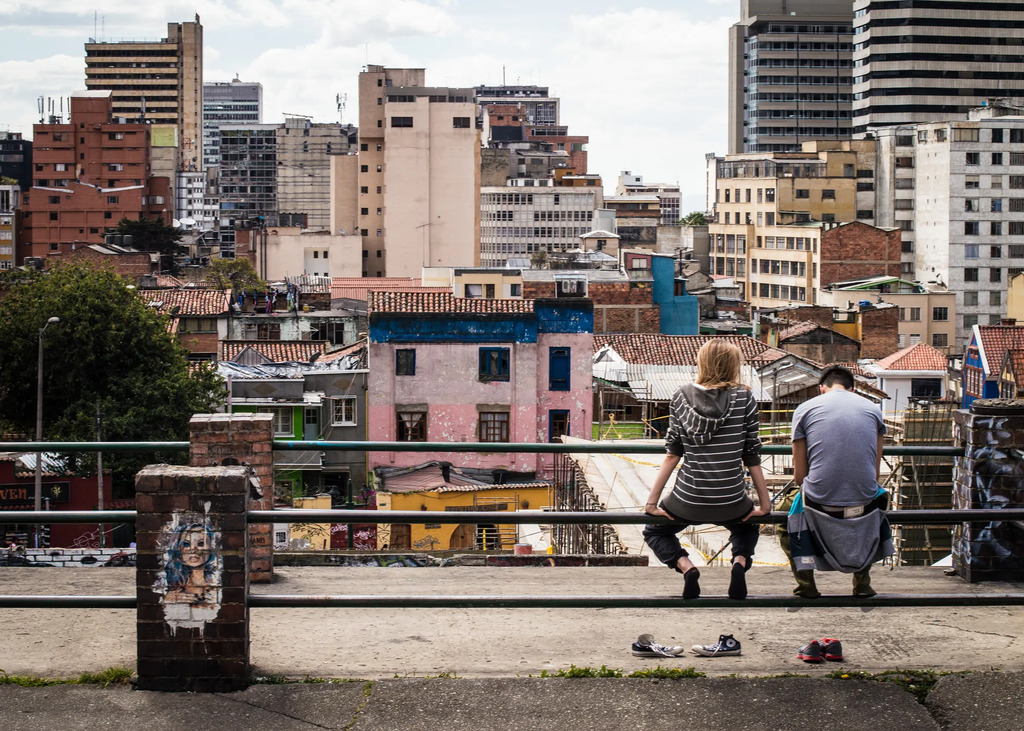
Bogotá, Colombia. Photography: Delaney Turner | Unsplash
Things are relative. “In the old days” used to refer to a past decade, a past century. But now last February has become “in the old days.” February now seems as remote as ancient Athens or the Middle Ages. It has moved away from us at an absurdly surprising speed. What happened? We are undoubtedly living through a time of crisis. But in just a few weeks, these crises have multiplied to such an extent that they have involved the entire planet, all of Humanity, all peoples, all individuals. This is no longer just one crisis. That is, the sum of the crises is not just one big crisis, one “big crisis.”
A crisis is always a spasm: it begins, intensifies, and then attenuates. However, when you have this multitude of simultaneous crises, it is a mutation—that is, the world from now on will be different. The world until the beginning of March was one thing, in mid-March it began to change, today, May, it is another world. That world in which we lived will no longer exist, it no longer exists. The everyday life of people, the daily routines of society—all of this has changed. Incidentally, crisis comes from the Greek krysis—arduous choice, difficult decision. The tension that is a crisis precisely involves the immense difficulty of choosing between alternatives. However, the real question is: the choice has to be made.
The change, when it occurs, brings difficult—but unavoidable, obligatory, necessary—choices. Now, the ancient Chinese sages clearly understood—and recorded in a famous ideogram—that every choice, while bringing difficulties, also indicates paths, suggests opportunities. It is because it is necessary to choose that new directions will be followed, that new Tomorrows will be built. That is, it's not because one wants to, or because it's philosophically cool to remember Chinese wisdom—it's because the decision has become absolutely necessary. We will no longer live as our parents did; we will not live as we lived just over a month ago.
Why? Because, as the Pernambuco poet Caio Lima said, the Anthropocene, the new geological era of Earth, is a pandemic. A pandemic, which is an epidemic not confined to a geographical location, but one that expands and rapidly reaches all regions, like a collection of simultaneous outbreaks distributed everywhere, well, that is a symptom of the Anthropocene. It expresses the fact that human activities have entered previously untouched natural reservoirs of germs. One of the characteristics of the planetary expansion of human societies that marks the Anthropocene is precisely the progressive alteration of natural environments, particularly with respect to species diversity.
By bringing human groups into contact with carriers of previously foreign germs, the environmental transformations induced by the incessant growth of economic activities foster the transmission of these germs to people—and, given the right circumstances, a virus will find a new field to operate in, become a pathogen for humans, and a new disease will begin to spread. The pandemic, therefore, is directly linked to one of the factors that define the Anthropocene, the age of humans.
Perhaps it could be said, then, that we are currently living through a phase of the Anthropocene—let's call it, why not?, the Coronacene—marked by a global outbreak of a variety of coronavirus. What does this mean, and what will come next? History clearly shows that we will come to live with the coronavirus. What comes next, therefore, is not after the coronavirus, but after with the coronavirus. No flu has ever ended; simply, flu has become part of our lives, and the coronavirus will also eventually be assimilated, like so many thousands of other pathogens. The duration of the assimilation process, however, is still very uncertain, as it depends both on the virus itself and on our immune system, as well as on the therapeutic initiatives and public health policies that will be applied.
What is the immediate outlook? How will we come to live with the coronavirus? For a period estimated to be between one and two years—if things go well—what should happen is that the initial impact will be overcome and local, rather than planetary, resurgences will begin. The technologies learned during the global pandemic outbreak will then be applied to these specific locations or regions where recurrence occurs.
If, for example, a new outbreak occurs in a given city, then quarantine and physical isolation practices, as well as the strengthening of health systems, should be applied until the situation is brought under control. Monitoring people's movement through cell phones has proven effective in restricting contact between healthy people and carriers, often unknowingly, of the virus. On the one hand, it can be a useful technique in dealing with the health crisis, but on the other hand, it raises serious concerns about democratic freedoms and individual privacy if continued after the outbreak. Difficult choices: that's what we have to make at this moment.
The expectation is that a safe and effective vaccine will be available in about two years, and in the meantime, treatments will be developed to help control the effects of the disease. However, it is crucial to understand that other pandemics will come. If the same causes occur, the same consequences should be expected. Scientists are already warning: ecosystems with high biodiversity—like the Amazon—and those subjected to predatory and uncontrolled exploitation—like the Amazon—are potential sources of new outbreaks. Scientific knowledge needs to be the basis for adopting essential preventive measures so that we can adapt to living with the new virus (and its mutations).
The most profound change that is coming, however, should affect the image that societies themselves have of themselves. We understood "normal reality," until the abrupt interruption caused by the pandemic, as a collectivity made up of atomized human beings. That is, I define myself exclusively from myself, from the choices I make, from the possessions I have. I am an atom, you are another; The idea that society is constituted from clashes or encounters between these atomized units is flawed. But evolution and history show us without a doubt that this is an entirely mistaken image of what human society is. It is a recent fabrication, a form of reductive subjectivation that aims solely to maintain and increase inequality in the distribution of goods, resources, and power among social groups.
The impact of the coronavirus has thus alerted us to the need to change this biased perception of what it is to be human—and, in parallel, of what nature is, of which we are a part. Quite different from what this individualistic and supposedly self-sufficient atomism suggests, we are only the people we are because we belong to a social body, and we are fully immersed, in all dimensions, in the natural environment that encompasses and constitutes us.
Society is not made up of ready-made and finished entities. By belonging to society, it builds me as much as I contribute to building it. Consequently, this means that the image of radical individualism as the foundation of sociability must be replaced, for practical reasons—that is, economic and ecological ones—by cooperative association. This, throughout history, has always been what has worked. Society only exists, in fact, because there is cooperation, in various ways and at different levels. Today, the urgent public health issue brought about by the pandemic makes this properly collective dimension of our existence very clear. Our actions would thus be guided not by personal gain and the privilege of the few, but by the ethical principles of collective understanding and collaboration.
It is to be expected that such a shift from radical individualism to active collaboration as an essential dimension in the constitution and operation of the public body will be the central element of an immense transformation of our worldview. Possibly, it will be experienced as the emergence from a trance, as a collective awakening after decades of general numbness.
As the great biologist Stephen Jay Gould observed, objectively, history is not made up of the actions of a few great names like Julius Caesar, Alexander, or Napoleon (generally, great murderers), as we tend to summarize it. The real fabric of life, he affirms, is the ten thousand small acts of kindness that we silently, unconsciously, offer each other every day: a mother tending to her child, a friend extending a hand to another, a passerby helping a complete stranger.
Perhaps, as an unforeseen side effect of the coronavirus tragedy, this basic understanding will become transparent to all of us: I am only because you are, I am only because we all are. My health is not only mine, it is also yours so that it can be mine. If this shift in ethical guidelines actually emerges throughout society, we will have a genuine earthquake in the current political structures—and a new world may begin to be born.
In conclusion, a notion that might guide the perspectives that the Museum of Tomorrow may outline in these first days of the Coronavirus crisis is that of resilience, as a form of active resistance. Consider this: a stone resists the flow of the current, immobile, rigid. Therefore, the stone does not learn, does not adapt, does not evolve. Bamboo, on the other hand, when the wind changes direction, bends, leans, undulates. It is firm, but it is flexible. This creative resilience, of that which resists but invests, of that which remains but transforms, of that which receives the blow but transforms it into a new movement; this is the perspective we should seek to undertake. Having as its firm core, as its fiber, this ideal of solidarity, of sharing, and of collaboration, so that we can serve people we do not know, simply because they are people, simply because they are what we are, and share with them the spirit and strength that pulsate in the heart of our white cathedral of ideas and dreams. And to share with them a loving imagination — that there will be, every day, ten thousand, twenty thousand, one hundred thousand small acts of kindness waiting for us. Every single day.