
COP Warm-up: Inspiring Agents for Climate Action
15/10/2024
Author
Thematic Axis
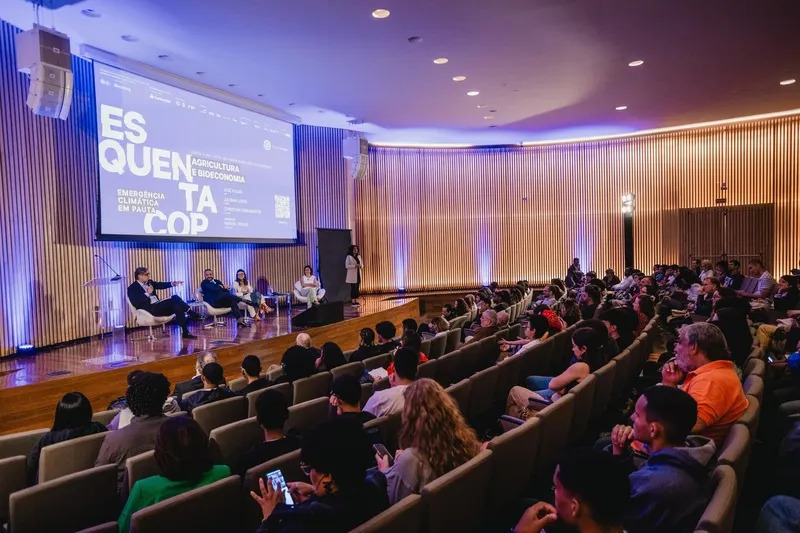
Warm-up Cop: Climate Emergency on the Agenda. Photo: Museum of Tomorrow.
The COP (Conference of the Parties) is the main international forum for discussing and negotiating solutions to the climate crisis. Since its creation in 1995, it has brought together governments, scientists, civil society, and communities to define concrete goals and actions that help curb global warming and reduce greenhouse gas emissions (Day 3. Culture and Climate...). In addition to being an official space for monitoring climate policies, the COP also promotes parallel meetings that broaden discussions and strengthen international cooperation.
Brazil is in a strategic position to lead these discussions, especially with COP30, which will take place in Belém in 2025. Given this responsibility, the Museum of Tomorrow organized the event "COP Warm-up: Climate Emergency on the Agenda", a series of debates and lectures that connects society to the COP agenda. The goal was to mobilize people and sectors around urgent issues such as energy transition, sustainable agriculture, and the intersection between culture and climate, promoting a space for collective reflection.
The Connection Between Climate, Culture, and Community
The COP Warm-up highlighted the need to rethink the climate crisis as a multidimensional crisis, involving both social and cultural aspects.
According to Thiago Jesus (People’s Palace Project), "thinking about the climate crisis, culture, and territory is one and the same." He emphasized that confronting this crisis demands respect and recognition of traditional communities, which already play an essential role in preserving ecosystems.
Marcele Oliveira (PerifaLab) added that "the climate crisis is also a crisis of imagination," highlighting that innovative solutions need funding and space to become reality. She challenged the audience to think: "Sustainability for whom? For what? And where?". These statements reinforce the importance of including new narratives and cultural perspectives in climate policies, broadening the dialogue beyond data and formal agreements.
The presence of indigenous peoples at the event brought a crucial perspective to the discussions. Leila Borari (Association of Indigenous Women Suraras of Tapajós and Amazônia de Pé) emphasized: "Imagine talking about climate without considering indigenous peoples, who contribute the most to the planet's balance." Indigenous culture was presented as a strong ally for environmental mobilization and preservation, connecting the climate emergency with a look towards the ancestral future.
Pathways to Action: Bioeconomy, Energy, and Agriculture
During the event, practical solutions were explored, such as strengthening the bioeconomy and sustainable agriculture. “The bioeconomy is a new model of sustainable development,” stated Juliana Lopes (CEBDS), reinforcing that Brazil has a historic opportunity to lead by example and become carbon neutral and positive.
Furthermore, the event debated the challenges of the energy transition, highlighting the need to abandon fossil fuels and adopt renewable energies. COP28, mentioned in the discussions, marked a global turning point by formalizing the urgency of this transition. However, as Christian Orglmeister (Suzano) pointed out, “it is in the territories that change happens,” emphasizing the importance of aligning global initiatives with local realities.
Brazil, as one of the world's largest agricultural producers, has a fundamental role in sustainable agriculture. The debate at the COP Warm-up event highlighted the potential of agroforestry systems and low-carbon agriculture to mitigate emissions and adapt the sector to climate change. These themes reinforce that the environmental crisis is also an economic and social crisis, demanding new practices and business models.
Mobilizing for an Ancestral and Sustainable Future
One of the main messages of the event was that the necessary climate transformation is radical and collective. “Every degree counts, every carbon emission makes a difference,” stated Thiago Jesus (People’s Palace Project), inviting the audience to act consciously and responsibly. Ana Santos added: “We are the environment, we are part of all this,” reminding everyone that the fight for sustainability is a personal and community issue.
The COP Warm-up event emphasized that change involves the inclusion of different voices and knowledge. “Climate negotiations need to include our relatives as an essential part of these mobilizations,” highlighted Camila Oliveira, General Content Manager of the Museum of Tomorrow, reinforcing the importance of involving indigenous peoples in political decisions. Beyond formal negotiations, the event was a call for cultural and community mobilization, aligning tradition and innovation in building climate solutions.
As a final reflection, Leila reminded everyone that "the future is ancestral," emphasizing that preserving traditions and nature is essential to guaranteeing a prosperous future. The event not only reinforced the climate urgency but also inspired the audience to see themselves as agents of transformation. The journey towards COP30 is an opportunity to lead a new era of climate action based on culture, imagination, and active hope.
. . . . . . .
This is original content produced by the Museum of Tomorrow's editorial team, reflecting our commitment to inspiring climate and cultural action for a sustainable future.Warm-up Cop: Climate Emergency on the Agenda. Photo: Museum of Tomorrow.