
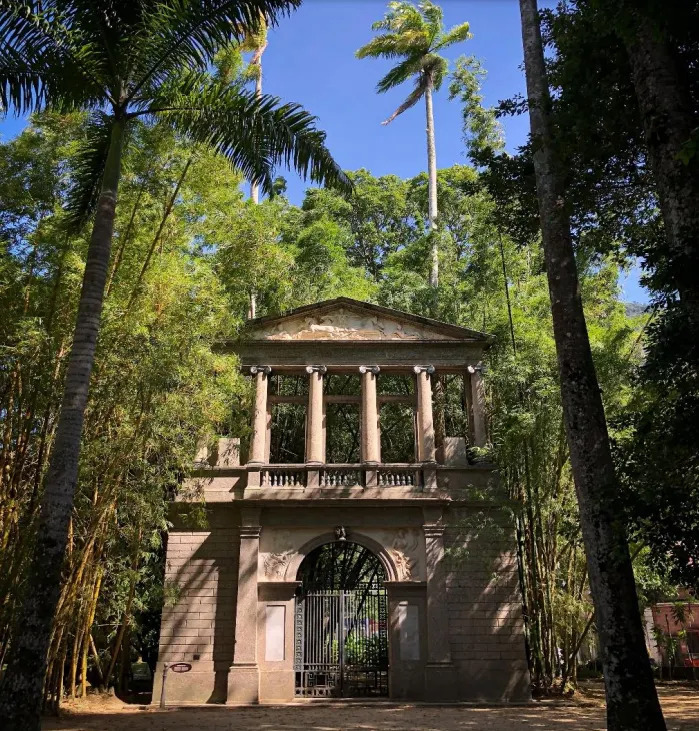
Rio de Janeiro Botanical Garden. Photo: Courtesy of the press.
Botany is the branch of biology that studies the plant world, an amazing universe that harbors diversity in all its aspects. There are more than 370,000 plant species in the world, with different habits, life forms, colors, textures, smells, tastes, interactions, and behaviors. Furthermore, plants also respond in varied ways to adversity, showing an even more impressive complexity—a theme explored in the article by researcher Luana Santos, on plant intelligence.
Plant Intelligence: A New Approach to the Study of Plants
The diversity on the planet may surprise us even more: it is estimated that about 9,000 tree species are yet to be discovered. In a recent study, researchers calculated the existence of 73,000 tree species in the world, which corresponds to an increase of approximately 14% compared to what we know today. This means that there is a vast universe to be discovered, mainly in Amazonian and Andean territories, which, according to the same researchers, harbor 40% of the still unknown trees.
In terms of botanical diversity, Brazil, which encompasses 60% of the Amazonian territory, stands out as the richest country in the world. There are over 52,000 known species, approximately 40% of which are endemic, meaning they occur exclusively in Brazilian territory. This diversity is closely linked to the country's different climatic and topographical conditions, which offer diverse environments such as forests, fields, wetlands, coastal scrublands, mangroves, and others. Furthermore, this number continues to grow, with the regular cataloging of new plant species—an average of 250 per year.
Even with all this richness, there is still much to discover. In the Amazon, a new species is recognized every two days. On the other hand, in the Caatinga, the lack of research and investment can generate a distorted view, suggesting that it is a region poor in terms of diversity. Thus, it is crucial to direct research efforts and resources to less explored areas in order to expand our knowledge and promote more effective conservation of the vast diversity that surrounds us.
Furthermore, little-known regions, such as some areas in Northern Brazil, face a greater danger of being transformed into planting areas, like soybean and sugarcane fields, or into areas for mineral exploration. Deforestation in these areas is happening very rapidly, exceeding our capacity to know and study all the species that inhabit them. This means that many species may disappear before they are even discovered, recorded, and understood. In other words, some may vanish without us even knowing they ever existed.
The lack of knowledge, coupled with significant transformations in the landscape, presents us with a great challenge: conserving the plant world. We are witnessing the extinction of species, some of which we never even got to know. And what is the impact of this? In practical terms, what are the consequences of these extinctions? Firstly, there is a broad discussion about the right to life—and beyond that, to existence itself—a value we carry with us. The extinction of a species has significant moral and ethical consequences. But beyond that, it is possible that this extinction will have other serious consequences.
The difficulty in knowing and studying all plant species and their interactions in nature leads us to a territory of uncertainty. For much of the planet's biodiversity, the answer to the question "What happens if this species becomes extinct?" is "We don't know." What we do know is that there is always a great loss. It's a life lost, countless ecological interactions that maintain the balance of ecosystems are lost. And furthermore, if we look at it from a more utilitarian perspective, we may be losing great medicinal potential or essential foods that could significantly benefit humanity.
Regarding the plant world, especially the importance of understanding and protecting its diversity, Gustavo Martinelli, a researcher at the Rio de Janeiro Botanical Garden Research Institute and General Coordinator of the National Center for Flora Conservation, shares his experience:
“During my scientific expeditions, upon returning to areas that were once balanced and diverse environments, today I see pastures, or gigantic condominiums, a plantation, or even deforested and abandoned areas, and this caught my attention. So I changed a bit, I moved away from the strictly academic pattern, whose metrics are based on how many articles you publish in scientific journals. At a certain point, I thought: if I want to save something, I have to go beyond the boundaries of this world, because if I write an article that will be published in major, important, and famous journals, how long does it take for that article to have a practical impact on protecting a place, a region, plant species? And that changed my course. I started to dedicate myself much more to practical and emergency actions, to worry much more about conducting basic research, recording and documenting the species that characterize the importance of concrete actions aimed at conservation.”
It is crucial, therefore, that we expand our knowledge, recognize the value of botany and, above all, respect the plant world, regenerating our connections for its benefit. Towards a more sustainable future.
Links for further reading:
1- https://www.worldfloraonline.org/
2- Cazzolla Gatti et al. (2021). Available at: <https://doi.org/10.1073/pnas.2115329119>.
3- Flora and Funga of Brazil. Rio de Janeiro Botanical Garden. Available at: <http://floradobrasil.jbrj.gov.br/>. Accessed on: April 15, 2024.