
Is it possible to imagine optimistic futures?
14/11/2023
Author
Thematic Axis
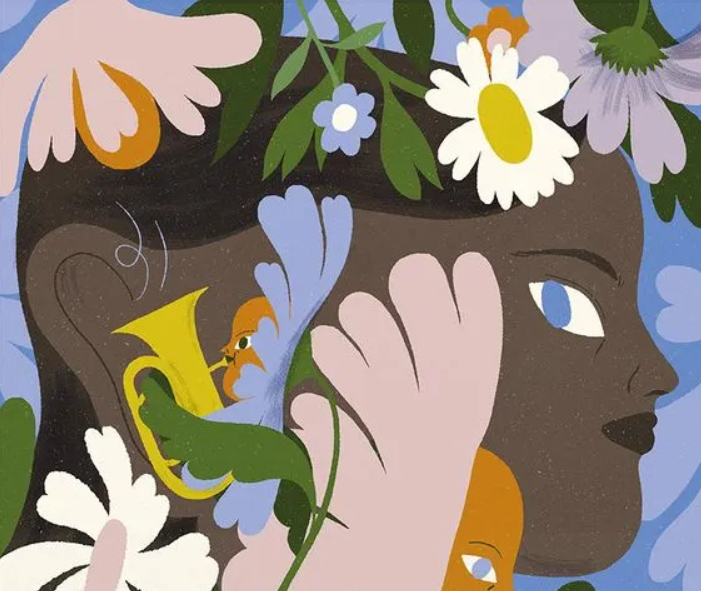
Illustrator Suvi Suitiala weaves natural motifs into her digital portraits. Credits: Suvi Suitiala.
Nature is not perceived in the same way by everyone, each individual has their own vision. There is a plurality of meanings about what nature is and in certain cultures, this word or another with a similar meaning does not even exist. This occurs in some Amerindian cultures, after all, for these people, nature and human beings are one. Human beings are part of a whole and live in full integration with the world around them.
For modern human beings, however, the relationship is unfortunately different. The modern hegemonic vision considers nature as an obstacle, an “ecosystem service”, a commodity or even a source of conflicts. In other words, for them, the relationship with nature is negligible or even non-existent, it has lost its meaning. This lack of connection with the whole was, in large part, what resulted in the new geological era we are living in, the Anthropocene. The first that has such great interference from a species that it even bears its name. Our species has affected the planet, to the point of putting its own survival at risk, through the complex socio-environmental crisis that we have created; characterized by the climate emergency, loss of biodiversity, pollution and several other factors that are becoming increasingly frequent due to the influence of the human species on the planet.
Given this scenario, what to expect in the future? We generally relate the Anthropocene to the idea of the end: the end of resources, the end of biodiversity, the end of humanity and the planet. This ends up generating negative and dystopian ideas about the future, which on the one hand are important for understanding the problem we have caused, but on the other hand can leave us stagnant towards transformative change.
It is very difficult to act if our only vision of the future is the end, as people base their actions on what they believe about society and the future. Therefore, we also need to imagine a desirable and possible future to be able to find ways to overcome the crisis.
There are already projects that seek to counterbalance dystopian visions about the future, as is the case with the Seeds of the Good Anthropocene. This project takes into account that a desirable future will likely be radically different from the world we currently know and live in. However, this future will be made up of many already existing elements, called “seeds”, which could combine in unique and surprising ways to create an almost unimaginable future. Seeds are initiatives that represent a diversity of world views and values, and improve the social, ecological or economic dynamics of a territory, contributing to a more prosperous, fair and diverse future.
Initiatives such as the Seeds of the Good Anthropocene occur in several places around the world, including in Brazil, as is the example of the Movimento Viva Água Baía de Guanabara. The Movement has multiple actors who seek to connect and integrate efforts towards water security and climate resilience in the Guanabara Bay Hydrographic Region (RJ) and its 17 municipalities, through nature conservation strategies and transition to a sustainable economy. It works to carry out conservation and recovery actions for natural ecosystems, in addition to encouraging entrepreneurship with positive social and environmental impacts.
Looking at these examples in practice leads us to try to understand the crucial aspects that can build a “good Anthropocene”. The Viva Água Movement brings integration between different actors, bringing together the local community, organizations, institutions, universities, government and entrepreneurs, to generate a positive socio-environmental impact. This integration, which to be achieved requires communication and dialogue, is essential for us to build plural futures, which does not just address a modern and hegemonic vision of what the future can be like. People can have very different opinions about what a good quality of life entails and what values are most important for human happiness and well-being. In other words, multiple paths are needed to achieve a series of desirable alternative futures.
We need to recognize that diversity of thoughts, ways of being and means of connecting people and nature are vital to overcoming local and global challenges. Better, more inclusive futures need to embrace complexity, heterogeneity and spontaneity. Dialogue and collective construction are necessary, as a future for everyone cannot be imagined by a few.