
Innovation and plurality in the art of hope
22/05/2025
Author
Thematic Axis
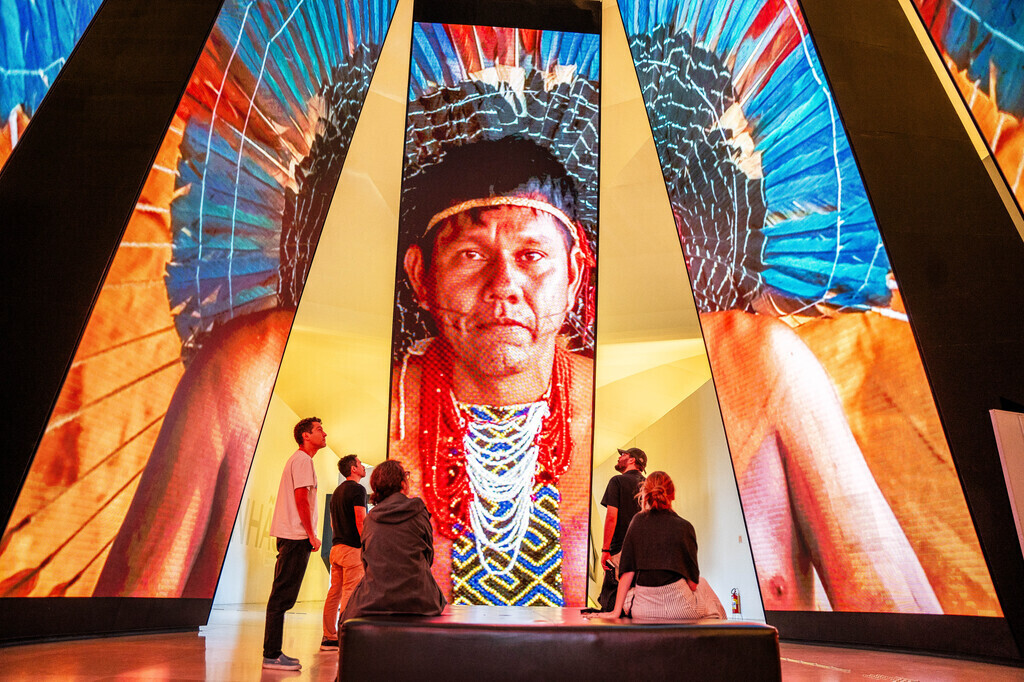
Video installation Anthropocene. Photograph: Museum of Tomorrow.
Hope is more than dreaming about better futures The Museum of Tomorrow, since its opening in 2015, combines science, art and innovation to inspire social and environmental transformations, being a space for belonging and diversity. With educational and scientific programs, it promotes accessibility, critical training and community engagement. In 2025, it will expand its dialogue between art and science, renewing exhibitions and strengthening its role as a platform for reflection and action about the future.— is to work for them. And, since we opened the doors, almost ten years ago, this is what we have done at the Museum of Tomorrow: a place where science, art and innovation meet to inspire real transformations.
Opened in 2015, with an architecture that became a symbol of Rio and installed in the heart of Little Africa, the Museum was born as part of the legacy of Rio 2016. But it soon became much more than that: it became a meeting point, a space for belonging and a platform for new ideas. Here, diverse voices, powerful stories and artistic expressions of all types intersect, helping to reflect — and act — on the great challenges of our time.
The proof of this is in our audience: more than 40% do not usually visit museums and 22% have their first museum experience in Ajante. With initiatives such as the Neighbors of Tomorrow program — which already has more than 7 thousand residents of the region registered —, the relationship with the community is lively, direct and transformative. It's people from the surrounding area participating, creating, taking part.
This diversity is also seen within the team. Today, 3% of our employees have some type of disability; almost half are black or brown people; 25.5% are black women; 25% are part of the LGBTQIAPN+ community; and 61% of leadership positions are held by women. This is not by chance — it is a choice, it is a commitment.
In the educational area, we remain firm in our aim to make science more accessible and interesting for everyone. We do this with interactive experiences, teacher training and activities that range from childhood curiosity to complex discussions about sustainability and climate justice. We want to train critical, creative people, ready to lead the changes that the world needs.
On the scientific front, the focus is to unite knowledge and action. We are engaged with urgent topics such as gender equity in science, literacy in futures (in partnership with UNESCO), the appreciation of female researchers and the open debate on the climate crisis.
Our Tomorrow's Activities Laboratory (LAA) is the space for experimentation and connection with the now. Here, we offer free workshops, artistic residencies and projects that combine art, science and technology — always with the community at the center and the future as the horizon.
All of this is only possible because we believe in management made by people, for people. A management that values meetings, listening and the plurality of perspectives that make up Brazil. And it is this approach that has made the Museum of Tomorrow one of the most visited and inclusive in South America: there have been more than a thousand activities, 45 temporary exhibitions and 13 virtual ones since its opening.
Now, we enter a new cycle. In 2025, we will further expand the dialogue between art and science, with the opening of 1,200 m² dedicated to artistic exhibitions linked to our central themes. We are also working on a new Museum Plan and updating the permanent exhibition — one that has already led more than 7 million people to reflect on who we are, where we came from, where we are... and, most importantly, where we want to go.