
Carbon offsetting of the Museum of Tomorrow's emissions will benefit the ceramics industry in Pará.
20/08/2020
Author
Thematic Axis
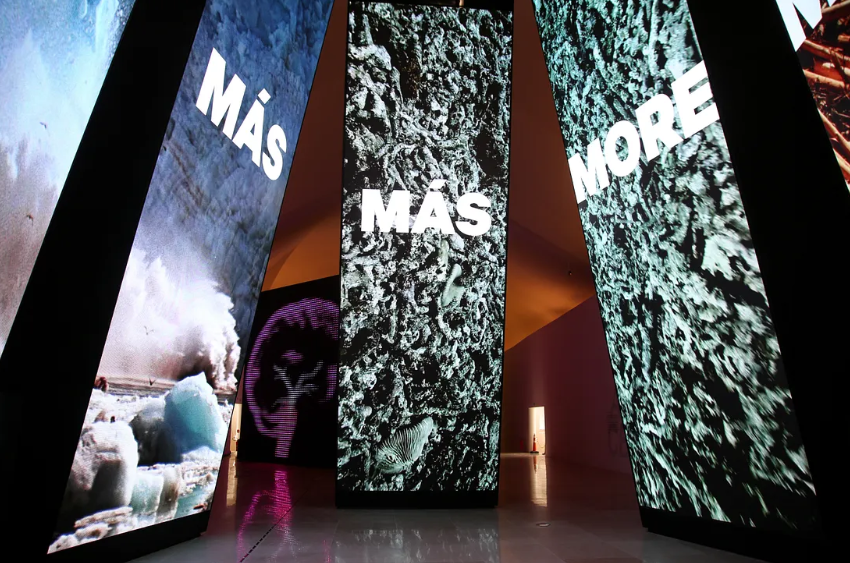
Detail of the Anthropocene. Photograph: Museum of Tomorrow.
For the fourth consecutive year, the Museum of Tomorrow will offset its greenhouse gas emissions, following guidelines that make the institution a global example of sustainability, being the only Brazilian museum with a gold seal in the GHG Protocol Program of the Center for Sustainability Studies of the Getúlio Vargas Foundation (FGV).
This process was carried out through a partnership with Banco Santander Brasil, which supported the preparation of the Museum's emissions inventory, with the company Sustainable Carbon. The offsets were made with the support of the Cerâmica Barbosa project. The project is located in São Miguel do Guamá (Pará) and the reduction in emissions comes from replacing the use of native firewood in its kilns with renewable fuels (for example, açaí seeds and Brazil nut shells). The funds raised will go towards modernization, donations to the local community, and training courses for the ceramics factory employees.
In 2019, the Museum of Tomorrow emitted 354 tons of CO2 equivalent, the lowest annual amount since it opened its doors to the public. Several factors are taken into account when calculating emissions, such as electricity consumption, air travel by museum staff and guests, waste generation within and in the immediate vicinity of the facility, and even the recharging of fire extinguishers.
This year, the Museum of Tomorrow also included the transportation of potentially recyclable waste to its final destination in the calculation. Advances in metrics ensure, once again, that the Museum of Tomorrow is a carbon-neutral museum. The inventory calculates the emission of all gases that produce the greenhouse effect—the warming of the Earth's temperature—and converts them into a unit equivalent to CO2 emissions, hence the term CO2 equivalent.
In the carbon market, an institution or company that avoids the emission of 1 ton of CO2 equivalent generates 1 carbon credit. These credits can then be sold to companies that have emitted greenhouse gases to offset their emissions. This is the case of the Museum of Tomorrow, which, despite various measures to reduce its emissions, inevitably emits some of these gases. Thus, the Museum of Tomorrow offsets its emissions and becomes carbon neutral, while also benefiting social products that invest in environmental sustainability. The Museum of Tomorrow has been offsetting its emissions, in partnership with Santander Brazil, since its opening in December 2015, helping to make our planet cleaner and more sustainable.
ANNUAL CARBON EQUIVALENT EMISSIONS OF THE MUSEUM OF TOMORROW
424t — 2016
520t — 2017
360t — 2018
354t — 2019