Book club: 19 science fiction authors share their literary references
21/07/2023
Author
Thematic Axis
Art: press release
Hello, visiting reader!
Every storyteller is a reader of other stories. If you are passionate about science fiction and fascinated by the possibility of exploring new universes, then the exhibition Sai-Fai: Brazilian Science Fiction is a must-see destination for you. Sai-Fai invites us to embark on a journey to the future, through an exhibition that challenges the boundaries between reality and imagination, giving life to Brazilian speculative fiction.
The story begins back in 2021, when the Museum of Tomorrow held a speculative fiction writing workshop at the Laboratory of Activities of Tomorrow (LAA). Inspired by movements such as Afrofuturism and Indigenous Futurism, 19 authors from all over Brazil created stories full of alternative realities, utopias, dystopias, and fantastic adventures. This workshop, which had the mentorship of leading figures in fiction in the country, became the starting point for the exhibition that fascinates us today.
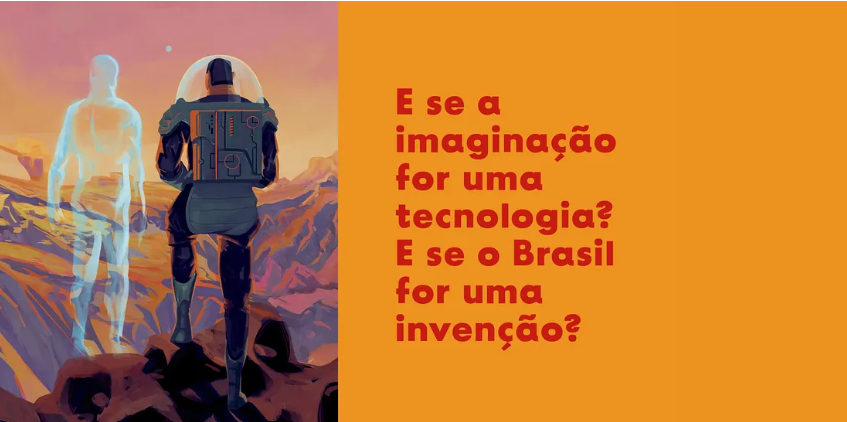
The exhibition Sai-Fai: Brazilian Science Fiction is an experience that transcends the pages of the stories written in the workshop. Ten Brazilian visual artists illustrate the stories, placing the written word in sensitive contact with the visual arts. The digital book, which is part of the exhibition, takes us on a journey through multiple narratives. Sound, image, and word merge in the museum space, inviting us to question the boundaries between what is real and how imagination can be a technology.
And to further enrich this experience, we asked the authors: Which book changed your life?
Adonias Pimenta Jr., Pau dos Ferros/RN, 1988:
“Which book changed your life?”, “What’s your favorite movie?” or “Which song deeply touches you?”… I love answering these kinds of questions because they help me remember important themes and works, and also because I always end up giving different answers. This way, I can share more stories and works by artists who influence me. This time, choosing a book that greatly influenced my perspectives, I'm going to recommend the graphic novel “Até o Fim” (Until the End) by Eric Peleias (script), Gustavo Borges (drawings), and Michel Ramalho (colors). It's a story that begins with the characters' destinies, showing their coexistence in a relentless yet light and altruistic way. A highly recommended Brazilian graphic novel.
Bia Sá, Rio de Janeiro/RJ, 1955:
I encountered this question several times during my Literature studies, but I'm choosing one I read after graduating. Naomi Alderman's *The Power* came into my hands during a time of transition, when I was rediscovering myself as a writer and a queer woman. What I wanted to bring to literature was something I questioned a lot, and this was one of the books that brought me closest to the answer (I can't say it's a final answer, since I'm still alive and writing). Even though this book is difficult and the writing isn't incredible, I was captivated by the possibility of having stories that deal with female anger, this fury we have towards patriarchy and the various injustices it has brought to the world. Like this author and many others who inspire me, I don't want to write comforting stories. I want to disturb. Even if it's with a simple story with only female characters set on Jupiter.
Brunno Apolonio, Belém/PA, 1985:
“At the Foot of Guaymiaba” is a product of my experiences traversing these same islands, of the relatives I encountered on the paths of contemporary Indigenous literature and art, but above all of the works and stories I accessed along the way. However, “There Isn’t There,” by Tommy Orange, captivated me with such power and emotion that it encouraged me to write fiction.
The novel is breathtaking in its understanding of the experiences of Indigenous people in an urban context, dismantling stereotypes and excavating a part of Indigenous history in North America in the asphalt of Oakland, making us reflect on ancestry, identity (and the loss of ethnic memory), community life in the city, and the technologies we continue to master while inhabiting these places. And although oppression and the reflections of colonialism are markers in the work, the resistance, the natural enchantments of being Indigenous, the intimacy with the territory, and the respect for the memory of ancestors left me speechless. This book inspired me to retell stories from our point of view, now starting from these immense springs in the Amazon Basin.
Carlus Cantoni, Rio de Janeiro/RJ, 1976:
Released here in Brazil in the eighties by the Argonauta collection, "The Brotherhood of the Talisman," by Clifford D. Simak, is one of the literary works of fiction that has most marked me. In this work, the author mixes hard fiction with fantasy; this fusion of styles fascinates me to this day. My current works are directly influenced by series, films, and comics from the 80s and 90s. And I use sai-fai to address inspiring themes or those involving everyday situations, but always trying to show part of the duality of our psyche and how we can or cannot remain human in the face of these situations. I try to show part of this in my story "External Threat."
Caroline Sampaio Ribeiro, Manoel Vitorino/BA, 1994:
Don't Look Behind the Door, by Lia Neiva. The book I read at the end of my childhood, which showed me that there was a word, the unusual, for all those ranges of real and invented stories, oral and written, from near and far, stories that stirred the density of the air and provoked fear. This book cultivated my imagination. To this day I remember the words on the back cover, which said, "Don't look behind the door, unless you wish to plunge into the world of the unusual and the fantastic."
It's not a science fiction book, but what I write is more fantastic and unusual than scientific. I can say that anything I write is inspired by the feelings caused by Lia Neiva's stories, without disregarding my other influences.
Daniel Rosa, Santo André/SP, 1989:
“It’s difficult to choose just one book, but I can choose one that opened doors for me. I’ve always been a reader of fantasy and science fiction and never really cared much about books outside those genres. It was a book I bought by accident at a newsstand for ten reais called *The Brief Wondrous Life of Oscar Wao* that opened up a world of fiction that could be as fantastic as any imaginary world and dystopian futures. I ended up encountering an almost historical novel about an immigrant family that I couldn’t stop reading for a second, despite the immense footnotes. It was a book that made me realize that reality can be as fantastic as any other universe and that what drives a story at the end of the day are captivating characters, no matter how many. It made me see Latin American literature with different eyes and seek to go beyond Pedro Bandeira and the Vagalume collection with Brazilian literature itself.”
Davenir Viganon, Alvorada/RS, 1983:
Definitely it was *The Metamorphosis* by Franz Kafka. The contained unease and, above all, the sense of estrangement seemed to me the only fitting way to see the madness that is the world. It's very common for fiction writers to feel obsolete when creating fantasy fiction when faced with the absurdities of reality that, if transposed into a story, would sound forced, breaking the suspension of disbelief. Kafka already knew how to circumvent absurdities, with even more absurdities, long before they reached the point we are at now. I learned a lot from this author, before developing a taste for science fiction, before Philip K. Dick and Ursula Le Guin amazed me with their humanism and empathy, before I had contact with the wonderful learning I had in the workshop. When I wrote *The Bara of Mars*, I wanted to convey the protagonist's estrangement from the world around him, from his support network, and especially from himself. *Diallo* wouldn't exist without Kafka.
Elisa Ferreira, Brasília/DF, 1997:
I've always liked science fiction and grew up watching Star Trek with my father. I've also always been passionate about fantasy worlds with magic and dragons. Then one day I became a vegetarian and started to feel that there was a lack of empathy in Sci-Fi in general—especially the blockbusters with evil aliens and planetary destruction. No, no, I needed something more… Frankenstein. The look at oneself, the ostracism, the vision of the "alien" as someone excluded from society by incomprehension, for thinking/acting differently and raising suspicions about their sanity (even when there is nothing suspicious, literally just different).
That's when I saw in science fiction a way to convey a message, both about my anti-speciesist views and about a better and more pleasant future for everyone—including terrestrial "aliens," who can't speak and aren't obligated to live in our civilized society, the animals.
Geo Amaral, São Paulo/SP, 1982:
Many influences have gradually shaped my way of putting stories on paper. I've explored the magical worlds of RPGs, the books of the Vagalume Collection, countless superhero comics, the horror of Stephen King, the fantasy on the edge of reality of Neil Gaiman, and even discovered with André Vianco that Brazil was a great stage for fantastic stories. However, one inspiration that, from adolescence to the present day, continues to mark me with the same power is the narrative of *Do Androids Dream of Electric Sheep?* (1968), by Philip K. Dick, adapted for the cinema by Ridley Scott as *Blade Runner* (1982). I was first captivated by the film, and then came to the book, and both are still examples for me of how to speculate on what it means to be human or non-human, what it is to live and die, and how we intertwine with a reality difficult to define without losing connections to everything around us.
Ghab Rod, São Paulo/SP, 1988:
Despite my strong appreciation for what is from our land, for what is Brazilian, and for many other authors, what impacted me most, creating a strong connection between myths, technology, and ancestry, germinated in a very immersive reading experience provided by the special collection of graphic novels known as Promethea, by the writer Alan Moore. In it, the author addresses themes that arise from conceptions interpreted as ancient religious and mythological knowledge, exploring mystical concepts of reality while we witness a complete evolutionary journey for the protagonist, who finds her truths far beyond what the matrix of daily life revealed to her. Reinterpreting her story through courage, knowledge, memory, and ancestry draws a perfect parallel between the short story I had the pleasure of producing for our anthology and this magnificent collection by this British author.
Giu Yukari (縁) Murakami (村上), Belém/PA, 1996:
“The Story of Your Life and Other Stories,” by Ted Chiang, was an anthology of short stories that showed me a new perspective on science fiction and how intimate this literary genre can become. His stories deeply affect us and make us reflect on time, culture, belonging, and identity. Ted Chiang is one of my inspirations in writing sai-fai and, without a doubt, his narratives gave me the courage to address such an uncomfortable theme as racism, fetishism, and dehumanization, as discussed in “On the Edge of Who I Am.”
Gyulia Felix, São Gonçalo/RJ, 1999:
“This question made me wonder if I had already found the long-awaited book that changed my life. And yes, I have. The book *A Court of Mist and Fury*, by Sarah J. Maas. Definitely very trendy, but the fact is: it was this book that showed me that words can take you to other worlds, make you live adventures, make you experience feelings intensely. This book, and the whole saga, made me feel part of a story created by a writer. And Sarah managed to show me that to engage someone, sometimes we don't need a thousand difficult words or developments that only the author will understand. Easy writing, but with depth, turns a book into a moment of peace for a reader. Writing full of feelings can make you live a thousand lives in one, through tiny letters on yellowed pages.”
Juliane Vicente, Porto Alegre/RS, 1993:
In *Kindred* by Octavia Butler, I found myself devouring a work in just a few minutes. For hours, I felt anguish on every page. Finding a story that blends fiction and reality, full of metaphors about power relations and racism, made me realize that I had predecessors who, with much struggle, paved the way in fantasy fiction for Black women like me. Exploring the past by questioning the structures that sustain the present was intrinsic to the literature I was developing. The perception that what I produced had a place of belonging and that this place was Afrofuturism came from this work. Like Dana, the protagonist, I was also a young writer traversed by time, like Octavia Butler I was also afflicted with a positive obsession that “[…] has to do with not being able to stop just because you are afraid and full of doubts. Positive obsession is dangerous.” "It has to do with not being able to stop at all." (BUTLER, 1989)
Márcio Moreira, Fortaleza/CE, 1989:
My life changed when I found a copy of *Torn Love Stories* by Marina Colasanti in the school library. I, who thought that a real book should stand on its own, discovered that literature could be made in another way: fantastic, direct, intimate, funny… A well-placed flick on the nose instead of the hard slap of the classics. That's when I understood that I could also experiment with writing in the laboratory of the sheet of paper.
My life had already changed before her and would change many more times afterward. I met Colasanti, Falcão, then Pratchett and Vonnegut, then Chiang and Borges, and each one unraveled more threads for my fabric. But the stitching of mycelium/sea, my story in *Sai-fai*, really came from Ursula K. Leguin. A fantasy author who taught me to exchange the killer story for the fiction bag and that literature can also... It could be done in a different way: fantastic, dense, intimate, and strange. And that's what I tried to do.
Pedro Drable, Rio de Janeiro/RJ, 1987:
“It's always difficult to answer these questions with just one title. I think my process of understanding the world and, consequently, of creation, necessarily involves associations from various sources. In the case of fictional and humorous writing, two books very clearly pushed me in this direction: *Comédias da Vida Privada* by Luiz Fernando Veríssimo, and *O Guia do Mochileiro das Galáxias* by Douglas Adams. They are two great authors who, starting from very different perspectives, bring very similar perspectives on curious human behaviors and tendencies. With Veríssimo, I learned how fantastic everyday life can be. With Adams, I discovered fantastic scenarios strangely similar to our daily lives. I am passionate about the writing of both and I am greatly inspired by the way they look at the world and at people.”
thalles, Juiz de Fora/MG, 1988:
To this day, no other book has had as much impact on my life as "The Stranger" by Albert Camus. A man who kills because of the sun, because it was too hot that day, is how I would summarize it, if necessary. It taught me that books can suffocate us and make us see ourselves as miserable, demanding that we accept this misery and yet still offer some kind of fraternity, asking us to continue. With it, I learned that, more than meaning or morality, stories need life. It's not a book that has inspired my writing style (I still don't know how I write, perhaps because I write little), it's more about a way of seeing, and that it's also possible to live in writing, in the letter, in every gesture.
The authors' answers to the question "Which book changed your life?" add layers of meaning to the exhibition, further enriching our journey through Sai-Fai's world. It's an invitation to become an active reader, exploring uncharted worlds and building, side by side with the writers, desirable futures.
. . . . . . .
Service
Sai-Fai Exhibition: Brazilian Science Fiction
Location: Museum of Tomorrow
Dates: July 25th to November 12th
Hours: 10 AM to 6 PM
Address: Praça Mauá, 1 — Centro, Rio de Janeiro — RJ
Prepare to embark on an epic literary journey, where the future intertwines with imagination and knowledge. We'll be waiting for you there!