
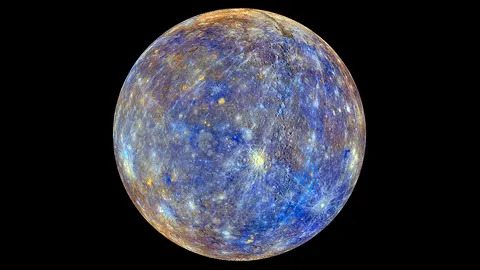
View of Mercury captured during NASA's Messenger mission • NASA/Johns Hopkins University Applied Physics Laboratory/Carnegie Institution of Washington.
The small and mysterious planet Mercury, the closest to the sun in our Solar System, has been challenging and surprising planetary scientists for decades. Recently, new research has revealed an intriguing characteristic: Mercury is shrinking.
According to a study published in the journal Nature Geoscience, as the planet loses heat, its wrinkled surface shrinks. These "wrinkles" are formations known as "scarps," which Professor David Rothery of the Open University in the United Kingdom compares to the wrinkles that appear on an apple as it ages. The first evidence of this phenomenon dates back to 1974, when images from NASA's Mariner 10 mission revealed these scarps several kilometers high.
Further revelations were brought by the Messenger probe, which orbited Mercury between 2011 and 2015, detecting even more of these formations. According to Rothery, these observations allowed the deduction of the presence of underground geological faults known as thrust faults, evidencing a total shrinkage of about 7 km in the planet's radius. However, most of the escarpments are estimated to be 3 billion years old.
To prove that the changes are still ongoing, researchers turned their attention to another formation: grabens. These are smaller structures, only about 1 km long and less than 91 meters deep. Surprisingly, these structures have a lifespan of up to 300 million years. In the recent study, scientists identified 48 definitive grabens and another 244 probable ones, all captured by the Messenger probe in 2015. This reinforces the idea that Mercury is undergoing active geological transformations.
In addition to the physical changes on the planet's surface, the research revealed that Mercury experiences tremors, similar to terrestrial earthquakes, but which Rothery jokingly calls "mercuryquakes." This occurs due to the planet's continuous shrinking, causing displacements in its rigid crust.
Scientists are eager for the next chapter in the exploration of Mercury. The BepiColumbo space probe, which already captured an image of the planet in 2021, is scheduled to bring back new high-resolution images soon. Until then, the mystery of Mercury will continue to fascinate and inspire the scientific community.
For more fascinating discoveries about the universe, get in the mood with the scientist from the Museum of Tomorrow.