

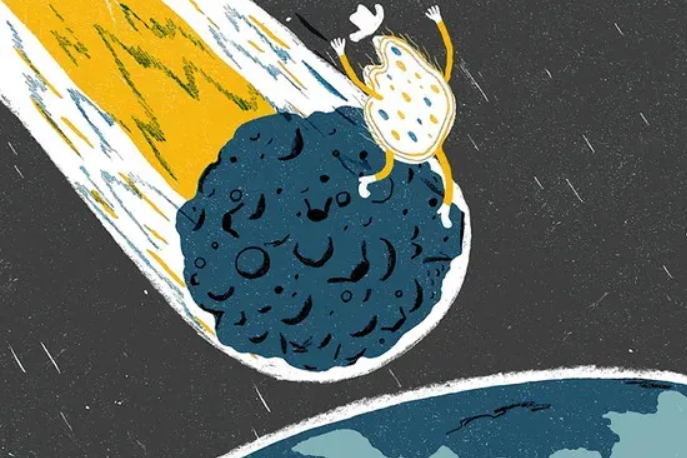
Image obtained from a public image website. Author and source unknown.
Ever since humans began looking up at the heavens, we've questioned our place in the vast universe. One of the most intriguing questions that science seeks to answer is: “How did life begin on Earth?” One fascinating hypothesis that has gained traction over the years is that of Panspermia.
What is Panspermia?
The theory of panspermia suggests that life, or at least the chemical precursors of life, may have originated outside Earth and were brought here via meteorites, asteroids or comets. This means that instead of life originating entirely here, microorganisms or biological molecules may have traveled through the vast voids of space to eventually land on our planet.

(Image: Paysages hivernaux / Pierre-Abraham Rochat)
Frozen Worlds and Life
With recent space missions exploring icy moons like Europa (from Jupiter) and Enceladus (from Saturn), the idea that life can exist in places previously considered inhospitable has become increasingly acceptable. If life can exist in these extreme environments, who's to say it didn't start there and then travel through space?
Evidence of Panspermia
While panspermia is still far from being accepted as fact, there is some evidence to suggest it may be possible:
1. Meteorites: Some meteorites found on Earth contain complex organic molecules, suggesting that the building blocks of life may be common in space.
2. Resistance of Microorganisms: Studies have shown that certain microorganisms can survive the harsh conditions of space for prolonged periods. If they could survive on a comet or asteroid, they could theoretically travel from one planet or moon to another.
While the idea that life on Earth may have extraterrestrial origins may seem like the stuff of science fiction, science is only beginning to scratch the surface of this profound theory. As we continue to explore our solar system and beyond, who knows what evidence we might find to support or refute the intriguing idea of panspermia?