A landing in the Amazon region
22/04/2024
Author
Thematic Axis
Art: press release
Travel doesn’t just introduce us to new landscapes and monuments. Travel also introduces us to new people, and it is they who help us understand precisely what, at first glance, is not revealed to the traveler: the habits, knowledge, memories and dreams that live in that place.
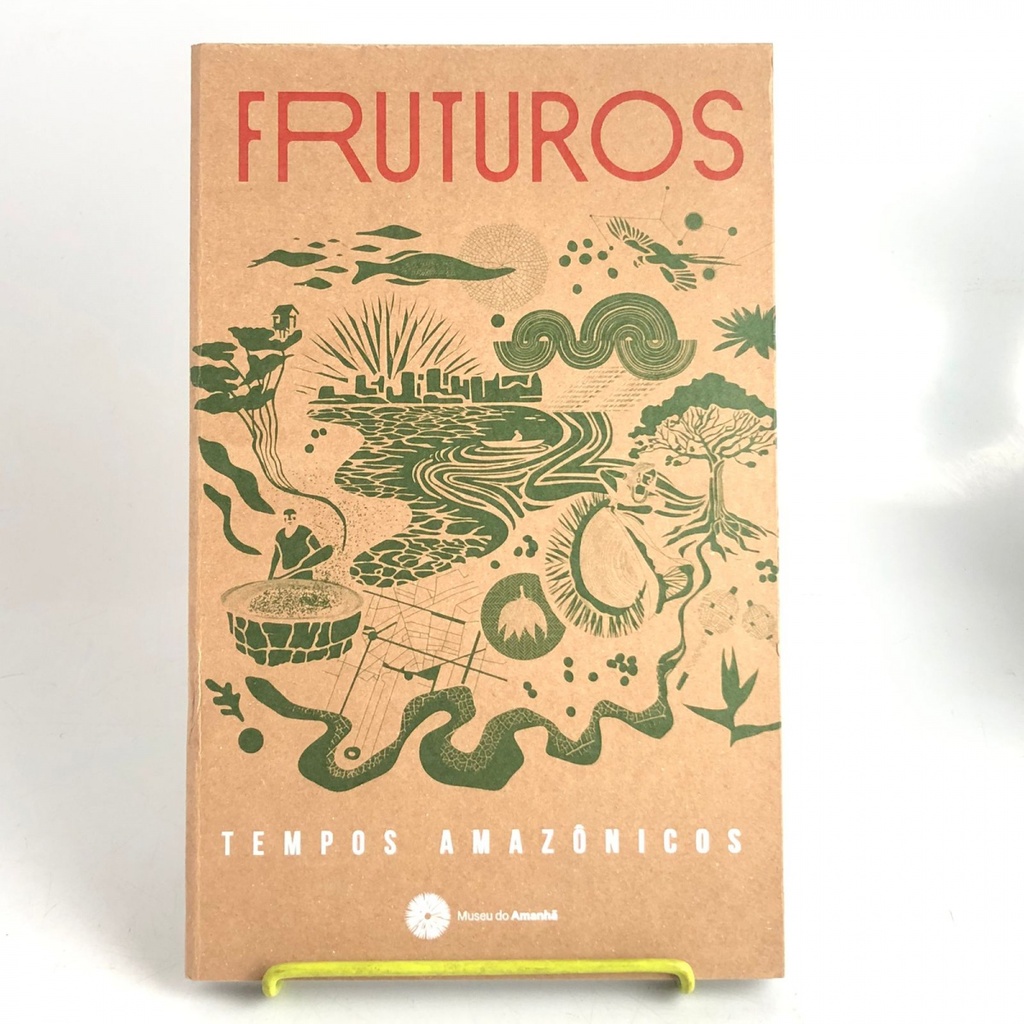
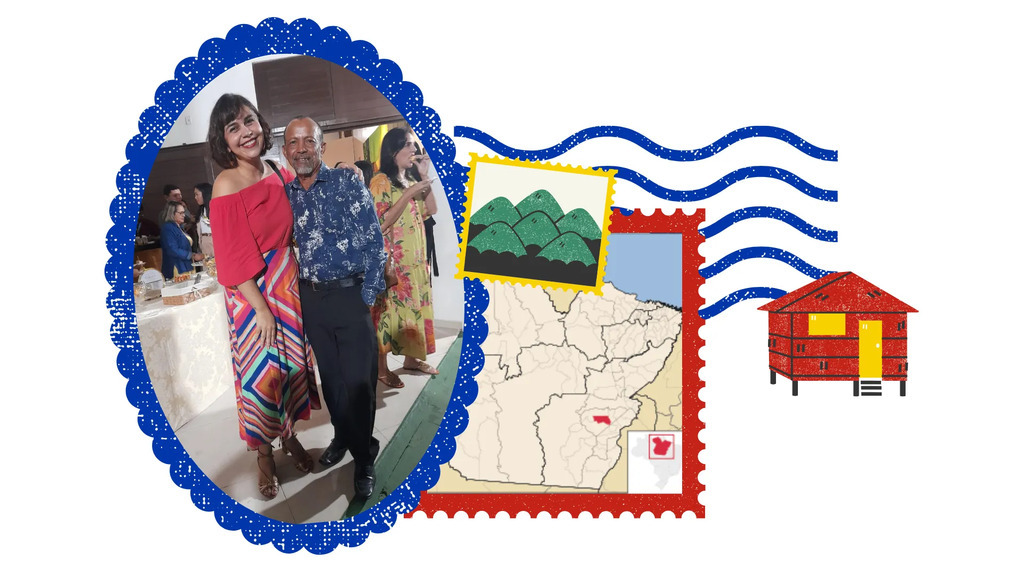
On a recent trip to the interior of Pará, I was able to learn a lot from a lot of people. And I brought in my luggage the words I heard from Seu Francisco — practically a history lesson. We met at the opening of the exhibition “Fruturos — Tempos Amazônicos” in Canaã dos Carajás, a city in the interior of Pará, 777 km from the capital, Belém.
The event began another phase of the itinerary of this exhibition, which was shown at the Museum of Tomorrow between 2021 and 2022 and now goes to four cities. In addition to Canaã, where it premiered on April 10, “Fruturos” has been showing in São Luís, capital of Maranhão, since March. The next stops are in Parauapebas, also in the interior of Pará, in July, and in Belém, starting in October.
This was the first time that Seu Francisco visited an exhibition — and, coincidentally, an exhibition whose theme is the territory where he lives and knows so well. In addition to showing the immense diversity and extreme relevance of the Amazon, “Fruturos” also highlights the consequences of the economic development model adopted over the last few decades and invites the public to think about possible paths so that the future of the region is more fair and sustainable.
Faced with a video that shows the impact of recent transformations and highlights that 20% of the original forest has already been degraded, Seu Francisco exclaimed: “I saw it all happen!” Born in Maranhão, he arrived in the Canaã dos Carajás region in 1979. At the time, everything there was forest, recalls Seu Francisco. But his father already had a worried feeling, seeing the political and economic direction of the country, that the landscape was going to change. “They’re going to tear everything down…” he said. Forty years later, Seu Francisco confirms the correctness of his father's prediction: “He was right, nowadays all the land our family had has become pasture”.
There was a tone of regret in his voice, but this should not be interpreted as discouragement or hopelessness. Well, while watching the images from the video, Seu Francisco concluded, as if talking to himself out loud: "But you can change that, see. You can recover the forest again, you can leave it as it was."
While listening to Seu Francisco, I imagined those two overlapping landscapes, that of the forest he knew in the past with that of the forest that he hopes the next generations will be able to see in the future. And I thought about the important role that memory plays in fueling our regeneration plans. Because, in opposition to the discourse that “this has always been like this”, it shows that other scenarios were and are possible.
But not all residents of the region, like Seu Francisco, remember this past and these transformations.Canaã dos Carajás was the city that grew the most, proportionally, over the last decade in Brazil. In a period of just 12 years, the city's population increased by 188.51%, going from 26.7 thousand inhabitants in 2010 to 77,079 people in 2022, according to IBGE data. And only 12% of residents were born and raised in the municipality; a large part of the population comes from Maranhão, Tocantins and Goiás.
These data help to understand why, throughout this trip, so many people commented that the “Fruturos — Tempos Amazônicos” exhibition provides a great opportunity to stimulate reflection on local identity. Although the city is in the Amazon region, there are those who identify the territory with the Central-West region. And it is worth remembering that there was even a plebiscite, held in 2011, to consult the population about the possibility of separating Pará into three states: Pará, Carajás and Tapajós.
What does it mean to be an Amazonian? And how can the term “Amazonian” account for the vast social plurality that exists in the Amazon? How can the identity of a community promote the preservation and/or transformation of the territory it inhabits? How do migratory flows influence environmental aspects — and are they influenced by them? It is questions like these that emerge when we think that the preservation of biomes involves, of course, factors that are political and economic, but are also cultural and symbolic.
The “Frutures” exhibition does not aim to provide ready-made answers to such a complex topic. One of its objectives is to contribute to this debate, showing how diverse the territory is and how this diversity needs to be considered when talking about a new development model for the region.
That's why it was so good to hear, both from the team at Casa da Cultura de Canaã dos Carajás and from visitors, that the exhibition promises to be fertile ground for a very productive conversation about memory, identity and representation. Because, just as happens on a good trip, an exhibition also gains other layers when it enables new encounters, leading to conversations that give access to other experiences and dreams. Like the one I had with Seu Francisco.