
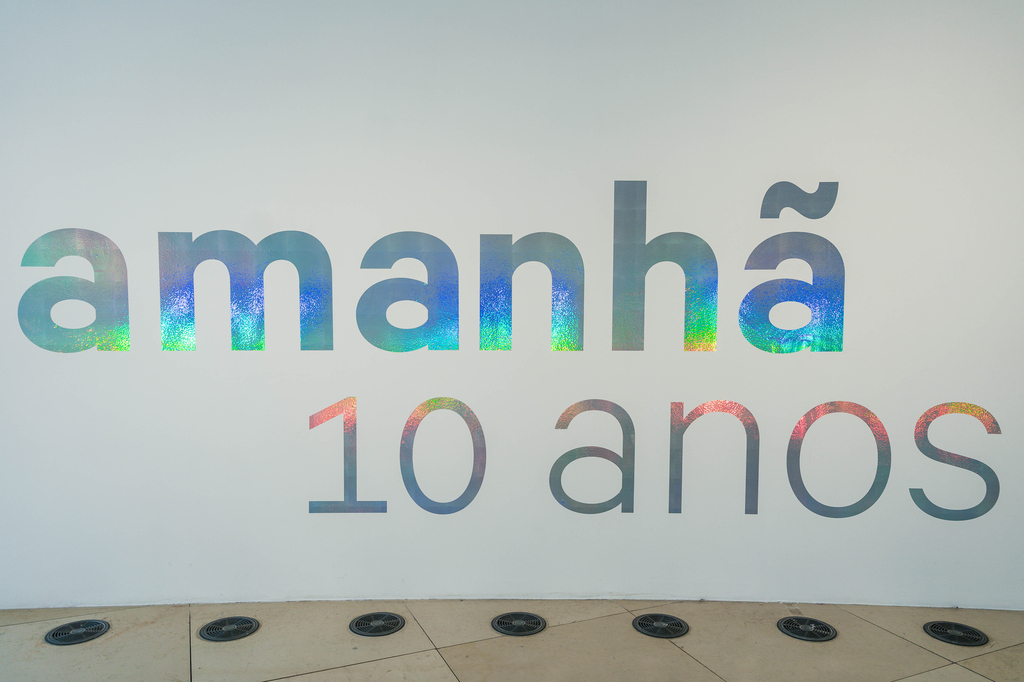
Exhibition "10 years tomorrow". Credits: Fabio Souza
Ten years ago, the Museum of Tomorrow opened its doors in the port area of Rio de Janeiro with a different proposal: to be a space for active reflection on the challenges and possibilities of current and future society. Today, as we celebrate this first decade of existence, we celebrate much more than an anniversary, we celebrate a cultural project that has established itself as a symbol of Rio de Janeiro, Brazil and a new way of thinking about museums in an innovative way in the 21st century.
Since its inauguration, Ajante has become one of the most visited cultural facilities in the country, welcoming millions of people of all ages, origins and territories. This public success is not just a statistical fact: it reveals the power of a museum that dialogues with urgent issues of our time — climate change, sustainability, advances in science, cultural diversity, ethics, coexistence and the role of human beings on the planet and how we want to move forward based on where we are today.
Over the years, our main exhibition and temporary exhibitions have provoked questions, stimulated critical thinking, and invited audiences to imagine futures. Our content dialogues in an inclusive and sustainable way. The Museum has established itself as a space where science, art, innovation and culture meet to inspire and hope. We are a museum that does not offer ready-made answers, but encourages conscious choices.
Dedicated to translating complex knowledge into accessible experiences, we bring diverse audiences closer to fundamental and everyday topics. More than 8 million people have already visited the equipment, and in 2025 alone we recorded 1 million visitors - with an audience made up of students, researchers, scientists, city residents, tourists from Brazil and around the world, this is a space for dialogue and reflection.
Tomorrow was born with the vocation of being a space for debates, a laboratory for ideas, for countless educational programs with the potential to impact entire communities, in addition to being the stage for major events as we saw in 2025.
The museum's legacy for the city of Rio de Janeiro is powerful, it expanded the population's access to educational experiences in an innovative way, and for Brazil, the equipment represents an affirmation that culture and science are strategic pillars for the country's social, economic and environmental development.
None of this would be possible without the dedicated work of the teams and our sponsors, the tireless researchers, educators, customer service, artists, the idg team that has been managing this museum for 10 years, and above all, the public, who have made and continue to make the museum a living space, in constant transformation. Every visitor who walks through our doors participates in the construction of our history.
As director of the Museum of Tomorrow, on this anniversary, I reaffirm my commitment to the values that have guided our trajectory since day one: talking about climate, sustainability, coexistence, art, innovation, ethics, ancestry and the paths we want to follow as a society. Guarantee access to culture as a right, respect for diversity, care for the environment and social responsibility for future generations. We will remain firm on the same path that has guided us here — attentive to changes in the world, open to dialogue and committed to innovation.
The coming years challenge us even more, and precisely for this reason, we have begun the renovation of our main exhibition. Our house continues to interact with current affairs, focusing on what we want for the future. We live in complex times, marked by uncertainty, but also by unprecedented opportunities for reinvention. Tomorrow will continue to be a space of hope, where different paths can be imagined, debated hopefully and constructed collectively.
Celebrating ten years is, above all, renewing the courage to continue asking: what tomorrow do we want? And, most importantly, what choices will we make today to make it possible.