
Características do Acervo
Numeração
MDA.MUS.00006.3
Suporte
Estrutura
Descrição e Autoria
Título
Instalação expositiva Cultura
Culture Exhibition installation
Culture Exhibition installation
Conjunto
Descrição
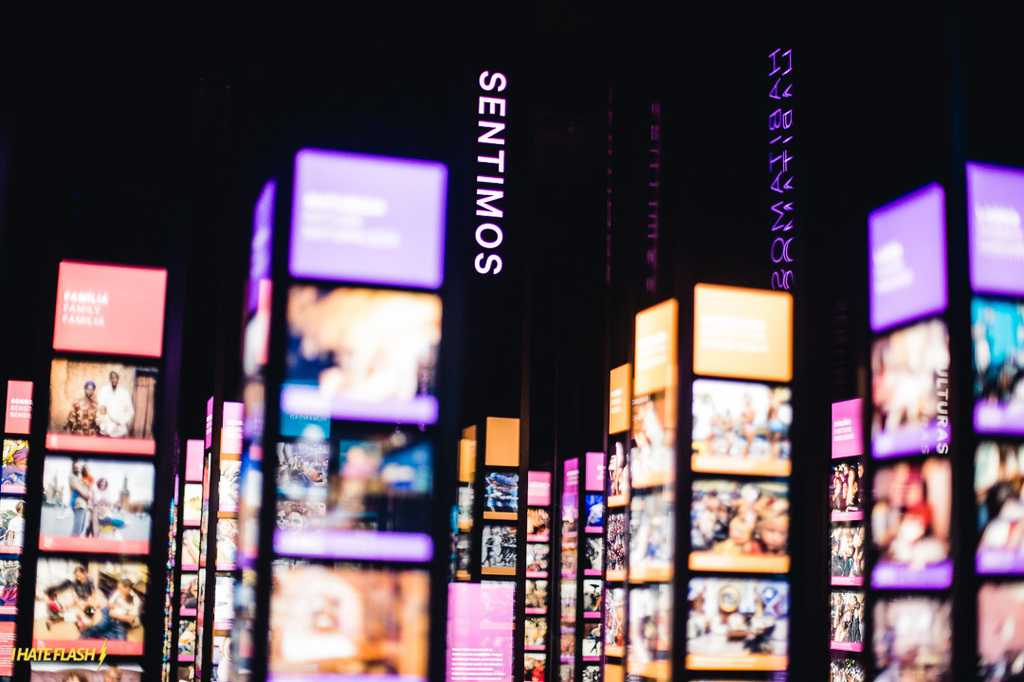
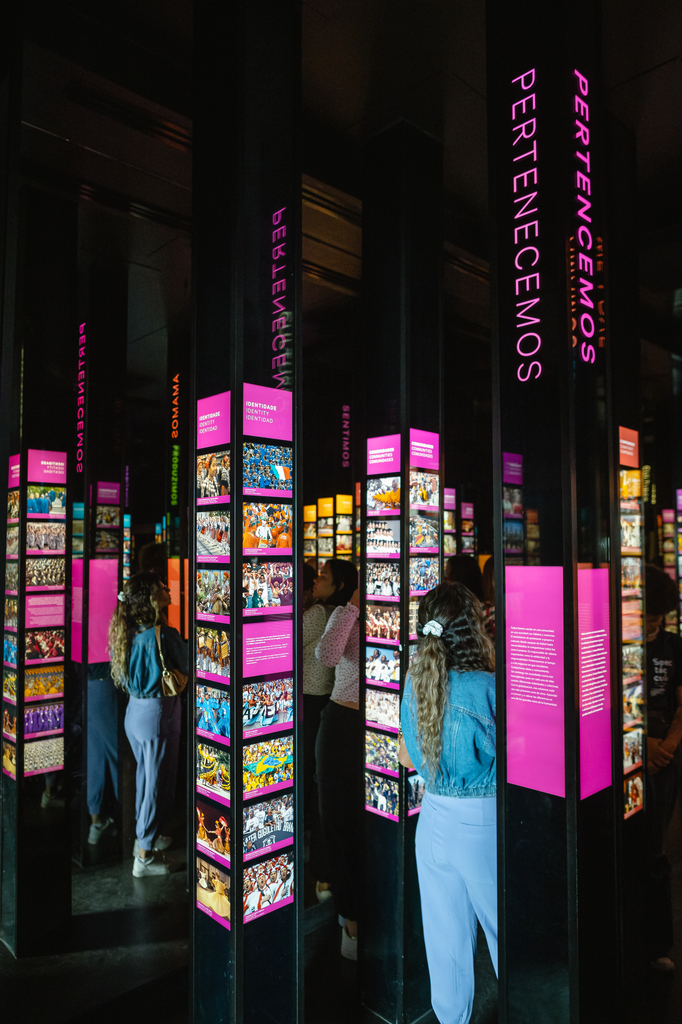
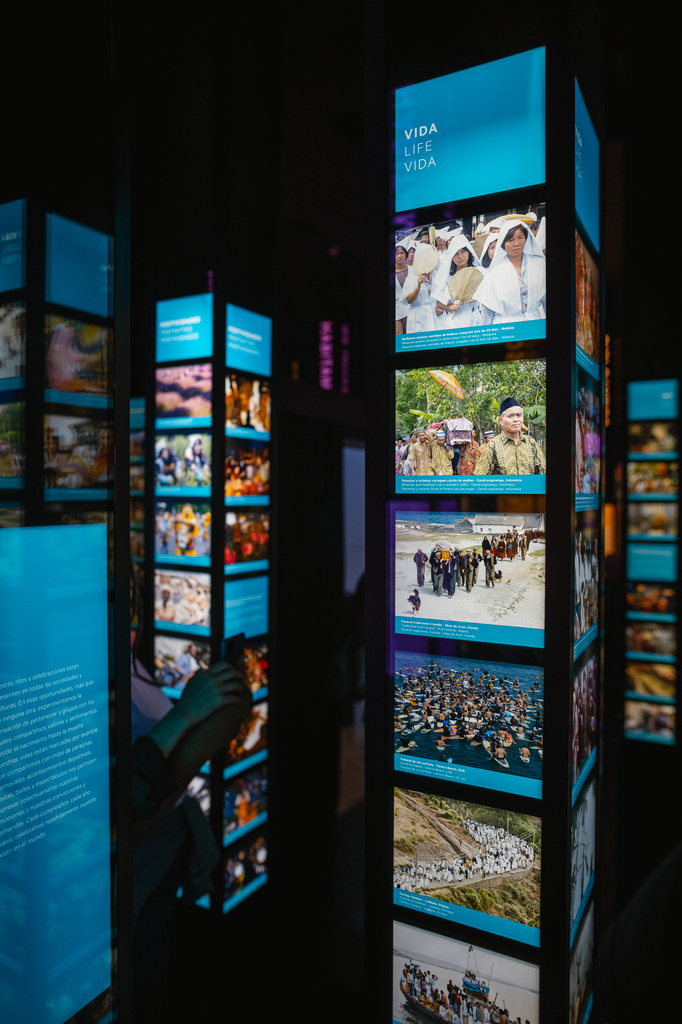
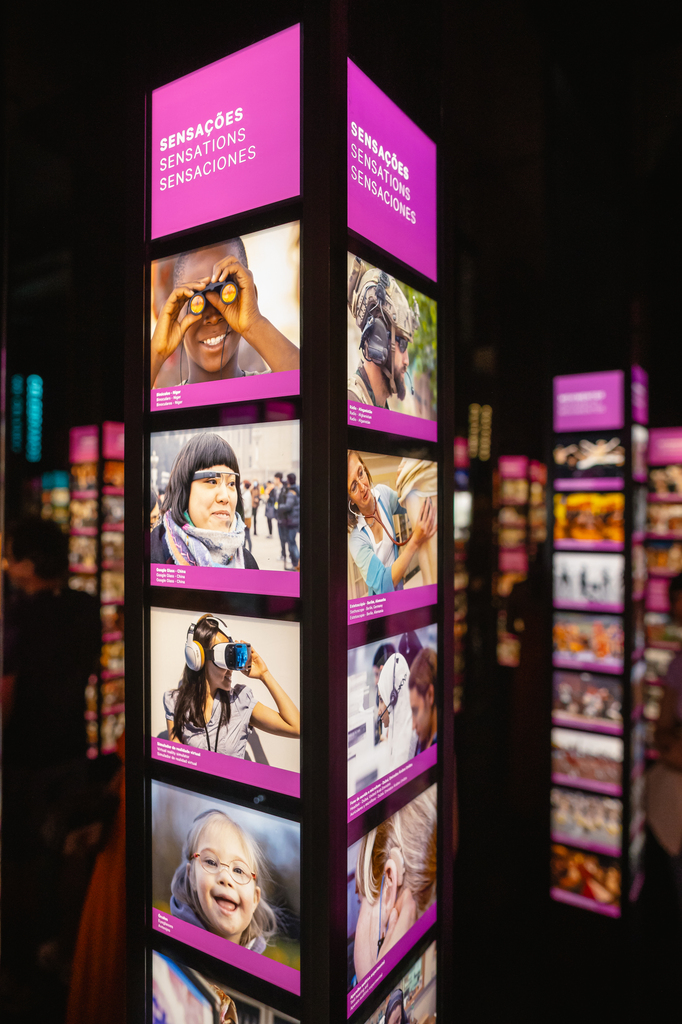
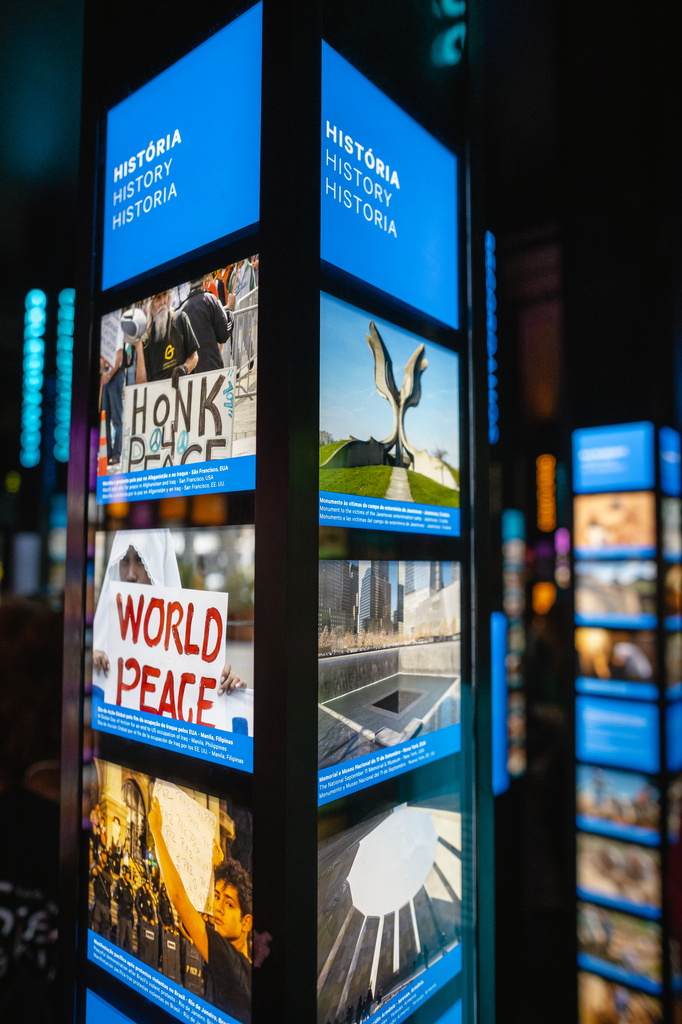
O interior do Cubo do Pensamento apresenta, por meio de mais de 900 fotografias distribuídas em 41 colunas, um panorama de diferentes aspectos da vida, da cultura, dos sentimentos e das ações humanas em diversas partes do mundo.
As imagens evidenciam modos de pertencimento, celebração, criação, disputa, crença, memória, afeto, produção e registro de experiências, reforçando a relevância da diversidade cultural.
As colunas são constituídas por vidro serigrafado em preto, com imagens e textos impressos em Duratrans e iluminação embutida na parte superior. As paredes internas do cubo são integralmente revestidas por espelhos, ampliando a percepção espacial e a multiplicação das imagens.
A proposta do ambiente é estabelecer uma relação entre a diversidade e as diferenças sociais e a capacidade do cérebro de se adaptar continuamente ao meio.
Dez faixas de áudio mixadas — compostas por diferentes elementos sonoros, como músicas, discursos, ruídos de transportes e vozes — complementam a instalação, criando um ambiente imersivo e fortalecendo a conexão entre as imagens e os textos apresentados.
Os textos relacionados ao Cubo do Pensamento encontram-se no campo Demais informações > Texto.
The interior of the Cube of Thought presents, through more than 900 photographs distributed in 41 columns, a panorama of different aspects of life, culture, feelings, and human actions in various parts of the world. The images highlight modes of belonging, celebration, creation, dispute, belief, memory, affection, production, and recording of experiences, reinforcing the relevance of cultural diversity. The columns are made of black screen-printed glass, with images and texts printed on Duratrans and built-in lighting at the top. The cube's interior walls are entirely covered in mirrors, amplifying spatial perception and multiplying the images. The environment aims to establish a relationship between diversity and social differences and the brain's ability to continuously adapt to the environment. Ten mixed audio tracks—composed of different sound elements, such as music, speeches, transportation noises, and voices—complement the installation, creating an immersive environment and strengthening the connection between the images and the texts presented. Texts related to the Cube of Thought can be found in the Additional Information > Text section.
The interior of the Cube of Thought presents, through more than 900 photographs distributed in 41 columns, a panorama of different aspects of life, culture, feelings, and human actions in various parts of the world. The images highlight modes of belonging, celebration, creation, dispute, belief, memory, affection, production, and recording of experiences, reinforcing the relevance of cultural diversity. The columns are made of black screen-printed glass, with images and texts printed on Duratrans and built-in lighting at the top. The cube's interior walls are entirely covered in mirrors, amplifying spatial perception and multiplying the images. The environment aims to establish a relationship between diversity and social differences and the brain's ability to continuously adapt to the environment. Ten mixed audio tracks—composed of different sound elements, such as music, speeches, transportation noises, and voices—complement the installation, creating an immersive environment and strengthening the connection between the images and the texts presented. Texts related to the Cube of Thought can be found in the Additional Information > Text section.
Coleção
Legenda
Cubo do Pensamento: Cultura. 2015. Instalação fotográfica e sonora composta por 21 torres com 28 fotografias, 4 textos e mixagem sonora distribuída em diversos pontos do espaço. ≅ 200 x 650 x 650 cm.
.
Cube of Thought: Culture. 2015. Photographic and sound installation composed of 21 towers, with 28 photographs and 4 texts on each, and sound mixing distributed at various points in the space. ≅ 200 x 650 x 650 cm.
.
Cubo del Pensamiento: Cultura. 2015. Instalación fotográfica y sonora compuesta por 21 torres, con 28 fotografías y 4 textos en cada una, y mezcla de sonido distribuida en varios puntos del espacio. ≅ 200 x 650 x 650 cm.
Acessibilidade
Dados Técnicos e de Localização
Categoria de acervo
Técnica de confecção
Edição de somTécnica
ImpressãoTécnica
Instalação sonoraTécnica
Mixagem de somTécnica
MontagemTécnica
SerigrafiaTécnica
Técnica mistaTécnica
Material
Cabo de açoMaterial
Backlight (retroiluminação)Material
Fotografia digitalMaterial
LumináriaMaterial
Espelho bronze 4mmMaterial
MP3 (MPEG-1/2 Audio Layer 3)Material
Piso vinílicoMaterial
Tinta epóxiMaterial
VidroMaterial
Dimensão
≅ 200 x 650 x 650 cm
Formato de arquivo
Resolução
variável
Tamanho do arquivo
variável
Duração
variável
Relações
Exposição
Outro item do acervo relacionado4
Demais informações
Texto
Textos das torres, que compõem a instalação expositiva:
CULTURAS Somos humanos porque imaginamos e utilizamos linguagem simbólica. Com a palavra e a técnica, migramos para todas as regiões do planeta, criando a diversidade das culturas. Vivemos em sociedade e pertencemos a famílias, grupos e comunidades com os quais nos identificamos. Cada cultura possui um repertório de conhecimentos e comportamentos comuns, renovados pela história e por experiências coletivas. Fazemos as mesmas coisas, de modos sempre distintos. Sensações, emoções, gostos, crenças, línguas e costumes formam o imenso caleidoscópio da riqueza cultural dos povos. Somos humanos porque formulamos e compartilhamos ideias capazes de transformar a realidade em que vivemos. Somos humanos porque somos culturais.
ACREDITAMOS Como dar sentido ao que vemos e experimentamos ao longo da vida? Como entender as razões da nossa alegria e da nossa dor? Crenças e ritos são parte da história de todas as sociedades. Rituais, costumes, regulamentos e instituições organizam a vida em comum. O conjunto de crenças que orienta atitudes e preenche de sentido nossa existência não se restringe às religiões. Valores como verdade, justiça e conhecimento também são fundamentais para a vida das comunidades.
a. Crenças
Os cultos ayahuasqueiros, disseminados principalmente na Amazônia, caracterizam-se pela utilização ritual da bebida psicoativa ayahuasca, também conhecida como Santo Daime ou Vegetal. Nos ritos dessas correntes religiosas, os fiéis bebem a substância alucinógena para viver uma experiência espiritual.
b. Religiões
(Texto I)
O cristianismo, o islamismo, o hinduísmo e o budismo são as maiores religiões do mundo em números de adeptos, com 2,3 bilhões, 1,5 bilhão, 1 bilhão e 470 milhões de fiéis, respectivamente.
(Texto II)
O Kumbh Mela é um dos maiores festivais religiosos do mundo, reunindo milhões de hindus a cada doze anos na Índia, para se banharem no encontro dos rios Ganges, Yamuna e Saraswati, em busca de purificação. Em 2013, cerca de 120 milhões de pessoas compareceram, ao longo de um mês de festival.
c. Mídia
A exibição da final do campeonato Super Bowl de futebol americano, nos EUA, em 2015, registrou uma das maiores audiências em eventos ao vivo da história da televisão mundial, com mais de 114 milhões de espectadores sintonizados.
PERTENCEMOS Todos nascemos em uma comunidade, em uma sociedade com hábitos e crenças. O sentimento de pertencer a grupos e culturas, de torcidas de futebol a nacionalidades, é compartilhado por todos os seres humanos. Esse sentimento é responsável por valores importantes como solidariedade e responsabilidade. Pertencemos ao tempo e aos espaços onde circulamos. Compartilhamos ideias e conhecimento. Mas as sociedades nunca são homogêneas, pois, em cada uma delas, existem diferenças individuais e coletivas.Com a globalização, nos tornamos cada vez mais próximos uns dos outros. Aprender a conviver e valorizar as diferenças é um dos grandes desafios da humanidade.
a. Tradição
Sem texto
b. Identidade
(Texto I)
O Flamengo é o time brasileiro com maior número de torcedores - cerca de 32 milhões. Corinthians e São Paulo vêm em seguida, com 27 milhões e 13 milhões, respectivamente.
(Texto II)
Para os budistas, a cor laranja representa a essência da sabedoria, força e dignidade. Para os zen-budistas, o azul representa tranquilidade, ascensão, o infinito, pureza e cura. Os muçulmanos consideram o branco um sinal de pureza, paz e oração. Os cardeais cristãos usam vermelho porque ele simboliza o sangue, que eles estão dispostos a derramar em defesa da fé.
c. Comunidades
Somente 40% da população mundial mora em países com liberdades políticas e direitos civis, onde ideias são discutidas livremente.
PRODUZIMOS Criar e produzir bens essenciais para a existência por meio da técnica também faz parte da cultura. Trabalhar a terra, extrair matérias-primas, produzir utensílios, distribuir bens por meio de trocas e comércios são afazeres que garantem as necessidades básicas dos nossos modos de viver. Artesanato, manufatura e indústria transformam ideias em objetos por meio de ferramentas, máquinas e robôs. Em nosso dia a dia, consumimos de diferentes formas produtos muito variados e geramos muitos resíduos.
- Excesso
i. Texto: O mundo produz cerca de 1,3 bilhão de toneladas de resíduos sólidos por ano, e a projeção é de mais de 2 bilhões em 2025.
ii. Texto: O mercado mundial de bens de luxo movimenta, em geral, quase um trilhão de dólares americanos por ano, sendo que apenas 1/7 da população mundial possui uma renda mensal considerada alta.
- Agricultura
Sem texto
- Indústria
i. Texto: A produção mundial de eletrônicos girou em torno de 1,6 trilhão de dólares americanos em 2012, e estima-se que supere a marca de 2 trilhões de dólares americanos até 2020.
ii. Texto: A China é o maior produtor de equipamentos eletrônicos do mundo, respondendo por cerca de 38% do mercado, seguida da Europa, com 14%; dos Estados Unidos, com 15%; e do Japão, com 12%.
CRIAMOS Imaginação, invenção, técnica, arte, sonho. Criamos imagens, formas, espaços, narrativas. A diversidade cultural é resultado de nossa infinita capacidade criativa. Quando criamos algo novo ou resolvemos um problema complexo, a dimensão inconsciente é essencial. A criação constrói significados e produz identidades, alimenta tanto a arte como a ciência. É fonte das mais incríveis descobertas, das mais belas obras, assim como de nossas fantasias e ilusões.
- Criatividade
i. Texto: Criado em torno de 1600, o Kabuki é um dos estilos mais antigos de teatro japonês ainda em uso. Considerado patrimônio da humanidade pela UNESCO, o Kabuki é conhecido pela estilização do drama e pela elaborada maquiagem usada pelos atores.
- Imaginação
i. Texto: A primeira forma de escrita surgiu na Suméria, na região da antiga Mesopotâmia, entre 3000 a 3500 A.E.C. É conhecida como escrita cuneiforme - em forma de cunha - porque os sinais eram feitos com estilete sobre uma placa de argila macia.
c. Inovação
i. Texto: O bioquímico norte-americano Craig Venter e sua equipe criaram, em 2010, a primeira célula totalmente funcional controlada por um DNA sintético produzido em laboratório.
ii. Texto: Em 2015, a sonda Opportunity, da NASA, totalizou mais de 42 quilômetros percorridos em solo marciano ao longo de 11 anos, sendo a maior distância alcançada por um objeto humano em outro astro.
AMAMOS O amor e o afeto ocorrem de inúmeras maneiras. As relações conjugais, a familiaridade e o parentesco são os ingredientes básicos sobre os quais se assentam nossas vidas e estão presentes, de modos variados, em todas as culturas. Por isso, os ritos e costumes relativos à vida dos casais e à criação dos filhos são componentes essenciais de cada cultura. A sexualidade é um dos traços fundamentais da nossa experiência. Amar também é reconhecer e respeitar a diversidade de orientações sexuais e os direitos de homens, mulheres e crianças, em todo o planeta.
- Família
i. Texto: Calcula-se que a população de animais de estimação no mundo é de mais de 1,5 bilhão. O Brasil é um dos países com mais animais de estimação per capita no mundo: um animal para cada duas pessoas.
- Sensibilidade
i. Texto: O beijo na boca não é universal. Os tongas e os chewas, da África do Sul, acham o beijo repulsivo. Segundo antropólogos, muitos povos veem a boca como a morada da alma, que poderia se contaminar durante o beijo.
- Compromisso
i. Texto: Os casamentos são realizados há séculos e suas razões variam em diferentes culturas, como amor, religião, status social ou posse de propriedade. Existem tipos distintos de casamento, com a monogamia e a poligamia entre os mais praticados. A poligamia, que é o casamento entre três ou mais pessoas, é legalizada em pelo menos 47 países, a maioria islâmicos do continente africano e asiático.
LEMBRAMOS A memória é a dimensão fundamental de todas as culturas. É utilizando a memória e a linguagem que ensinamos e aprendemos. Grupos e sociedades passam, de uma geração a outra, seus saberes e estilos de vida, seus modos de ser, estar e agir no mundo. A todo momento, registramos, recordamos e renovamos nossos atos. preservação da memória em monumentos, bibliotecas e museus, por exemplo, tem papel indispensável na conservação e difusão das experiências culturais. São lembranças e lugares que nos fazem recordar os acontecimentos e guiam o futuro de cada um de nós.
- Patrimônio
i. Texto: O Museu Nacional, na Quinta da Boa Vista, no Rio de Janeiro, é o que conta com o maior acervo dentre os museus do país: 15 milhões de peças entre mobiliário, vestuário, coleção biológica, botânica, paleontológica e geológica.
ii. Texto: O Brasil possui cerca de 20 sítios reconhecidos como patrimônio mundial pela UNESCO, entre cidades históricas, como Ouro Preto (MG) e Olinda (PE), e paisagens naturais e culturais, como o Parque Nacional da Serra da Capivara (PI), o Pantanal (MT e MS) e as Cataratas do Iguaçu (PR).
- Antepassados
i. Texto: A Comissão Nacional da Verdade listou, em relatório final divulgado em 2014, 434 pessoas mortas ou desaparecidas durante o regime militar no Brasil (1964-1988). Entre essas pessoas, 210 são consideradas desaparecidas.
ii. Texto: Ao contrário do que ocorre no Brasil, o Dia dos Mortos é uma ocasião festiva no México. Ruas e cemitérios são enfeitados com caveiras coloridas e festas são realizadas para lembrar os que já se foram.
- História
i. Texto: O protesto contra a Guerra do Iraque em Roma, na Itália, em 15 de fevereiro de 2003, considerado um dos maiores protestos antibélicos da história, atraiu uma multidão estimada em 3 milhões de pessoas. No mesmo dia, entre 6 e 10 milhões de manifestantes reuniram-se em cerca de 600 cidades no mundo pelo mesmo motivo.
ii. Texto: O fim da Segunda Guerra Mundial em 1945 é celebrado oficialmente na Europa todo dia 8 de maio. Ao longo de quase sete anos, essa guerra custou a vida de mais de 60 milhões de pessoas.
iii. Texto: Em 9 de novembro de 2009, Berlim celebrou o 20° aniversário da Queda do Muro de Berlim com um Festival da Liberdade em volta do Portão de Brandenburgo. Um dos pontos altos foi quando mais de 1.000 peças de dominó supercoloridas, cada uma com mais de 2,40 metros de altura, foram empilhadas ao longo do antigo percurso da muralha no centro da cidade.
SENTIMOS Nossa relação com o mundo se estabelece pela sensibilidade. Vivemos cercados por imagens, cores e texturas que elaboramos a partir das sensações e símbolos que nos emocionam, despertam a nossa curiosidade e o nosso desejo. Sabores e aromas são parte de todas as culturas. A música e a dança nos falam diretamente ao corpo. Somos tocados pela alegria, mas também pelo sofrimento. Somos movidos pela simpatia e pela aversão, pela compaixão e pela ira, pela dor e pelo prazer. Somos humanos.
- Emoções
i. Texto: Diferentes culturas possuem variações no reconhecimento das emoções que se refletem nas expressões faciais. Enquanto 85% dos ocidentais reconhecem alegria em um sorriso, a mesma relação é feita por apenas 69% dos habitantes da Ilha de Sumatra, na Indonésia.
ii. Texto: Um dos eventos esportivos mais assistidos na história foram as Olimpíadas de Londres, em 2012, com cerca de 4 bilhões de espectadores que viram pelo menos parte dos jogos.
- Movimentos
i. Texto: Cerca de 50 práticas culturais com danças são consideradas patrimônio da humanidade pela UNESCO, Organização das Nações Unidas para a Educação, a Cultura e a Ciência.
- Sensações
i. Texto: Muitos povos indígenas usam perfumes não só para disfarçar os odores do corpo, mas também para curar doenças e purificar o ambiente. Os guajás, da Amazônia, têm o costume de usar fragrâncias obtidas de plantas regionais para repelir fantasmas.
DISPUTAMOS Não existe sociedade humana sem conflito. Com frequência, nossos objetivos pessoais estão em contradição com os dos outros. A ambição pode ser um sentimento positivo que alimenta a inovação e traz benefícios para nossas comunidades. Mas também pode conduzir à agressão e à guerra. Os jogos e os esportes, que existem em todas as culturas, servem para canalizar a competitividade entre os humanos. Assim como no esporte, a vida em sociedade requer a regulação dos conflitos, a fim de criar oportunidades para que prevaleça o bem comum. Disputas e diferenças sempre existirão, mas quando não há diálogo, a liberdade é ameaçada.
- Poder
i. Texto: Cerca de 30 países ainda vivem sob o comando de governos em geral classificados como ditaduras, em especial na África, no Oriente Médio e na Ásia.
- Competição
i. Texto: Atualmente, as Olimpíadas se restringem a competições esportivas, mas entre os Jogos de Estocolmo de 1912 e Londres de 1948 foram realizadas competições olímpicas de arquitetura, escultura, pintura, literatura e música.
- Igualdade/Liberdade
i. Texto: A cada três dias, em média, uma denúncia de intolerância religiosa chega à Secretaria de Direitos Humanos da Presidência da República do Brasil. As principais vítimas são as religiões de matriz africana, como o candomblé e a umbanda.
ii. Texto: Em 2013, o número de migrantes internacionais em todo o mundo foi de 232 milhões, contra 175 milhões em 2000 e 154 milhões em 1990. Migrantes são pessoas que vivem em um país diferente daquele em que nasceram. O número total de refugiados no mundo em 2013 foi de 15,7 milhões.
HABITAMOS Cada uma das culturas humanas constrói um modo próprio de habitar e viver. Habitamos diferentes espaços públicos e privados, das cavernas aos edifícios, das aldeias às cidades, das regiões às nações. Áreas naturais, como parques e praias, estão abertas à livre circulação de todos. Movimentamo-nos entre os espaços utilizando vias públicas, calçadas e variados meios de transporte individual e coletivo. Ao mesmo tempo, outros ambientes são restritos, regidos por hábitos e estilos de vida singulares. Nas casas e comunidades em que habitamos desde a infância, aprendemos a conviver uns com os outros. E a convivência é uma das condições mais importantes da vida social.
- Cidades
i. Texto: Tóquio, no Japão, é a cidade mais populosa do mundo, com cerca de 40 milhões de habitantes, seguida por Nova Délhi (Índia) com 25 milhões, Xangai (China) com 23 milhões e São Paulo (Brasil) com 21 milhões.
- Lares
i. Texto: Mais pessoas vivem em cidades do que em zonas rurais. Segundo a Organização das Nações Unidas (ONU), até 2050, 66% da população mundial será urbana.
ii. Texto: Muitos chineses acreditam que há um deus da cozinha que cuida da família. A cada véspera do Ano Novo chinês, a família se reúne para rezar para o deus da cozinha dar um bom relato aos céus sobre o comportamento familiar e para que ele retorne com boas notícias no quinto dia do Ano Novo.
- Natureza
i. Texto: A Antártida é a única grande região natural do planeta que não tem habitantes permanentes.
ii. Texto: Cerca de 1,1 bilhão de pessoas em todo o mundo - aproximadamente a população da Índia - ainda vivem sem acesso à eletricidade, a maioria na África e Ásia.
CELEBRAMOS Festas, ritos e celebrações estão presentes em todas as sociedades e culturas. Nessas ocasiões, mais do que em quaisquer outras, experimentamos a sensação de pertencer a grupos com os quais compartilhamos valores e sentimentos. Do nascimento à morte, nossas vidas são marcadas por eventos partilhados por milhares de pessoas. Carnavais, eventos esportivos, festas, danças e espetáculos nos permitem expressar coletivamente nossas emoções, bem como nossas convicções e reivindicações. A cada aniversário, a cada ano novo, celebramos repetidamente nosso existir no mundo.
- Festividades
i. Texto: O Círio de Nazaré, realizado em Belém do Pará desde o século XVIll, é uma das maiores procissões religiosas do país, reunindo anualmente mais de 2 milhões de romeiros em uma caminhada de quase 4 quilômetros em homenagem à Nossa Senhora de Nazaré. O percurso pode durar nove horas.
ii. Texto: Diferentes culturas celebram os equinócios de outono e de primavera, que têm origem pagã, como o Dia de Ação de Graças nos Estados Unidos e o Moon Festival na China.
- Vida
i. Texto: Na Coreia do Sul, a contagem dos aniversários é diferente. Considera-se que ao nascer todos já tenham 1 ano e um novo aniversário é celebrado no início de cada ano, de modo que, em comparação com uma pessoa nascida na mesma data no Ocidente, um coreano é sempre um ou dois anos mais velho.
ii. Texto: Entre os chineses, é tradição que os bebês só recebam seus nomes oficiais um mês após o nascimento, no chamado Ritual da Lua Cheia Mun Yueh.
- Humanidade
i. Texto: Alguns historiadores defendem que a palavra Carnaval deriva do latim carne vale, que significa "adeus à carne", remetendo à aproximação da Quaresma e do jejum da carne. Outros acham que teria origem em currus navalis que significa "carro naval" representando os carros em forma de barco que os gregos e os romanos usavam para festejar a chegada da primavera.
Texts from the towers that make up the exhibition installation:
CULTURES We are human because we imagine and use symbolic language. By expressing our thoughts in words and developing techniques and processes, we expanded to all regions of the planet, creating the diversity of cultures. We live in a society and belong to families, groups and communities with which we identify. Every culture has a repertoire of knowledge and common behaviors, renewed by history and collective experiences. We do the same things, but often in very different ways. Sensations, emotions, tastes, beliefs, languages and customs form the immense kaleidoscope of the cultural wealth of peoples. We are human because we formulate and share ideas capable of transforming the reality in which we live. We are human because we are cultural.
WE BELIEVE How can we make sense of what we see and experience throughout life? How can we understand the reasons for our joy and our pain? Beliefs and rituals are part of the history of all societies. Rituals, customs, regulations and institutions organize a shared life. The set of beliefs that guides attitudes and fills our existence with meaning is not restricted to religion. Values such as truth, justice and knowledge are also fundamental for the lives of communities.
a. Beliefs
Ayahuasquero services, disseminated mainly in the Amazon, are characterized by the ritualistic use of the Ayahuasca psychoactive drink. In the rites of these religious currents, followers drink the hallucinogenic substance to live a spiritual experience.
b. Religions
(Text I)
Christianity, Islam, Hinduism and Buddhism are the major religions of the world in number of followers, with 2.3 billion, 1.5 billion, 1 billion and 470 million followers, respectively.
(Text II)
The Kumbh Mela is one of the biggest religious festivals in the world, gathering millions of Hindus every twelve years in India to bathe in the meeting of the Ganges, Yamuna and Saraswati rivers in search of purification. In 2013, about 120 million people attended the month-long festival.
c. Media
The broadcast of the 2015 Super Bowl American football game in the US recorded one of the largest live event audiences in the history of world television, with more than 114 million viewers tuned in.
WE BELONG We are all born in a community, in a society with habits and beliefs. The feeling of belonging to groups and cultures, from football fan clubs to nationality, is shared by all human beings. It is responsible for important values such as solidarity and responsibility. We belong to the time and space in which we circulate. We share ideas and knowledge. But societies are never homogeneous - there are individual and collective differences in each of them. With globalization, we become more and more like neighbors. Learning to live together and to value differences is one of the great challenges of humanity.
a. Tradition
No text
b. Identity
(Text I)
Flamengo is the Brazilian football team with the most fans - about 32 million. Corinthians and São Paulo come next, with 27 million and 13 million fans, respectively.
(Text II)
For Buddhists, the orange color represents the essence of wisdom, strength and dignity. For Zen Buddhists, blue represents tranquility, ascension, the infinite, purity, and healing. Muslims consider white as a sign of purity, peace and prayer. Christian cardinals wear red because it symbolizes the blood that they are ready to shed in defense of their faith.
c. Comunities
Only 40% of the world population lives in countries with political freedom and civil rights, where ideas are freely discussed.
WE PRODUCE Creating and producing goods essential for our existence through the use of techniques is also part of culture. Working the land, extracting raw materials, producing utensils and distributing goods through exchanges and trade are all tasks that ensure the basic needs of our ways of living. Crafts, manufacturing and industry transform ideas into objects through tools, machinery and robots. In our day-to-day, we consume widely varied products in many different ways, and generate a lot of waste.
- Excess
i. Text: The world produces about 1.3 billion tons of solid waste per year, a number that is projected to surpass 2 billion by 2025.
ii. Text: The global market for luxury goods in general moves almost a trillion US dollars a year, while only 1/7 of the world population has what is considered to be high monthly income.
- Agriculture
No text
- Industry
i. Text: The global electronics marked reached 1.6 trillion US dollars in 2012, and is estimated to surpass the mark of 2 trillion US dollars by 2020.
ii. Text: China is the largest electronics producer in the world, accounting for about 38% of the market, followed by Europe with 14%, the USA with 15% and Japan with 12%.
WE CREATE Imagination, invention, technique, art, dreams. We create images, shapes, spaces, narratives. Cultural diversity is the result of our endless creativity. When we create something new or solve a complex problem, the unconscious dimension is essential.
Creation builds meaning and produces identities, and fuels both art and science. It is the source of the most amazing discoveries, of the most beautiful works, and of our fantasies and illusions.
- Criativity
i. Text: Created around 1600, the Kabuki is one of the oldest Japanese theater styles still in use. Listed as cultural heritage by UNESCO, the Kabuki is known for its stylized drama and the elaborate make-up worn by the actors.
- Imagination
i. Text: The first form of writing emerged in Sumer, ancient Mesopotamia, between 3000 and 3500 B.C.E. It is known as the cuneiform - wedge-shaped - writing system, because the symbols were carved with a sharp knife into a soft piece of clay.
c. Inovation
i. Text: American biochemist Craig Venter and his team created the first fully functional cell controlled by laboratory-produced synthetic DNA in 2010.
ii. Text: In 2015, NASA's Opportunity rover has roamed over 42 kilometers in Martian soil over 11 years, the longest distance achieved by any human object on another celestial body.
WE LOVE Love and affection occur in countless ways. Marital relations, familiarity and kinship are the basic ingredients upon which our lives exist, and they are present, in various ways, in all cultures. Therefore, the rites and customs related to the lives of couples and parenting are essential components of every culture. Sexuality is one of the fundamental traits of our experience. Loving is also recognizing and respecting the diversity of sexual orientations and the rights of men, women and children around the world.
- Family
i. Text: It is estimated that global pet population is more than 1.5 billion. Brazil is one of the countries with the most pets per capita in the world: one pet for every two people.
- Sensitivity
i. Text: Kissing on the mouth is not universal. The Thonga and Chewa, from South Africa, find kissing repulsive. According to anthropologists, many people see the mouth as the abode of the soul, which could be contaminated during kissing.
- Commitment
i. Text: Weddings have been performed for centuries, and the reasons for them vary in different cultures, including love, religion, social status or property ownership. There are different types of marriage, with monogamy and polygamy among the most practiced. Polygamy, which is marriage between three or more people, is legal in at least 47 countries, mostly in Islamic nations from Africa and Asia.
WE REMEMBER Memory is the fundamental dimension of all cultures. It is by using memory and language that we teach and learn. Groups and societies convey, from one generation to the other, their knowledge and lifestyles, their ways of being, living and acting in the world. At all times, we remember, record and renew our actions. Preserving the memory of monuments, libraries and museums, for example, plays an indispensable role in the conservation and dissemination of cultural experiences. These memories and places serve to remember what has happened, and to guide the future of each and every one of us.
- Heritage
i. Text: The National Museum in Quinta da Boa Vista, in Rio de Janeiro, has the largest collection of all museums in the country: it holds 15 million pieces, including furniture, clothing, and biological, botanical, paleontological and geological collections.
ii. Text: Brazil has about 20 sites recognized as World Heritage by UNESCO, including historic towns such as Ouro Preto and Olinda and natural and cultural landscapes such as the Serra da Capivara National Park, the Pantanal and the lguaçu Falls.
- Ancestors
i. Text: In its final report, released in 2014, Brazil's National Truth Commission lists 434 people dead or missing during the military regime in Brazil (1946-1988). Among those, 210 are considered missing.
ii. Text: Unlike Brazil, the Day of the Dead is a festive occasion in Mexico. Streets and cemeteries are decorated with colorful skulls, and festivities are held to remember those who are gone.
- History
i. Text: The protest against the Iraq war in Rome, in ltaly, on February 15, 2003, one of the largest antiwar demonstrations in history, drew a crowd estimated at 3 million. On the same day, between 6 and 10 million protesters gathered in about 600 cities in the world for the same reason.
ii. Text: The end of the Second World War in 1945 is celebrated officially in Europe on May 8. Raging for nearly seven years, the war cost the lives of more than 60 million people.
iii. Text: On 9 November 2009, Berlin celebrated the 20th Anniversary of the Fall of the Berlin Wall with a Festival of Freedom around the Brandenburg Gate. A high point was when over 1,000 colorfully designed foam domino tiles, each over 2.4 meters tall, were stacked along the former route of the wall in the city center.
WE FEEL Our relationship with the world is established by sensitivity. We live surrounded by images, colors and textures that we develop from the sensations and symbols that move us, that arouse curiosity and desire. Flavors and aromas are part of all cultures. Music and dance speak directly to the body. We are touched by joy, but also by suffering. We are driven by sympathies and disgust, by compassion and anger, by pain and pleasure. We are human.
- Emotions
i. Text: Different cultures vary in the way they recognize emotions in facial expressions. While 85% of Westerners recognize joy in a smile, the same connection is made by only 69% of the inhabitants of the island of Sumatra, Indonesia.
ii. Text: One of the most watched sporting events in history was the London Olympics in 2012, with about 4 billion viewers who viewed at least part of the games.
- Moviments
i. Text: About 50 cultural practices involving dance are considered World Cultural Heritage by UNESCO, the United Nations Educational, Scientific and Cultural Organization.
- Sensations
i. Text: Many indigenous peoples wear perfume not only to disguise body odors, but to cure disease and purify the environment. The Guajás, from the Amazon, have the custom of wearing fragrances obtained from regional plants to ward off ghosts.
WE DISPUTE There is no human society without conflict. Our personal goals are often at odds with those of others. Ambition can be a positive sentiment that fuels innovation and bring benefits to our communities, but it can also lead to aggression and war. Games and sports, which exist in all cultures, serve to channel competitiveness among humans. Just like in sports, life in society requires the regulation of conflict in order to create opportunities for the common good to prevail. Disputes and differences will always exist, but when there is no dialogue, freedom is threatened.
- Power
i. Text: About 30 countries still live under the command of governments generally classified as dictatorships, especially in Africa, the Middle East and Asia.
- Competition
i. Text: Nowadays the Olympics are restricted to sports competitions, but between the Stockholm Games in 1912 and the London Games in 1948, Olympic competitions included bouts on architecture, sculpture, painting, literature and music.
- Equality/Freedom
i. Text: Every three days, on average, a complaint of religious intolerance is received by the Human Rights Secretariat of the Presidency of Brazil. The main victims are African-Brazilian religions, like Candomblé and Umbanda.
ii. Text: In 2013, the number of international migrants worldwide was 232 million, up from 175 million in 2000 and 154 million in 1990. Migrants are people who live in a country other than the one where they were born. The total number of refugees in the world in 2013 was 15.7 million.
WE INHABIT Each human culture builds its own way of inhabiting and living. We inhabit different public and private spaces, from caves to buildings, from villages to cities, from regions to nations. Natural areas such as parks and beaches are open to the free movement of all. We move between spaces using public roads, sidewalks and various individual and collective means of transport. At the same time, other environments are restricted, governed by natural habits and lifestyles. In the homes and communities that we inhabit since childhood, we learn to live with each other. And coexistence is one of the most important conditions of social life.
- Cities
i. Text: Tokyo, Japan, is the most populous city in the world, with around 40 million inhabitants, followed by New Delhi (India) with 25 million, Shanghai (China) with 23 million and São Paulo (Brazil) with 21 million.
- Homes
i. Text: More people today live in cities than in rural areas. According to the United Nations (UN), 66% of the world population will be urban by 2050.
ii. Text: Many Chinese believe that there is a kitchen god who takes care of the family. Every Chinese New Year's Eve, the family gathers to pray to the Kitchen God to report favorably to the heavens about how the family behaved, and wishes for it to return with good news on the fifth day of the New Year.
- Nature
i. Text: Antarctica is the only major natural region of the planet without any permanent inhabitants.
ii. Text: About 1.1 billion people worldwide - about the size of India's population - still live without access to electricity, mostly in Africa and Asia.
WE CELEBRATE Festivals, rites and celebrations are present in all societies and cultures. At such times, more than in any others, we experience a sense of belonging to groups with whom we share values and feelings. From birth to death, our lives are marked by events shared by thousands of people. Carnivals, sporting events, festivals, dances and performances allow us to collectively express our emotions, as well as our convictions and claims. With every birthday, in every new year, we repeatedly celebrate our existence in the world.
- Festivities
i. Text: The Círio de Nazaré (Nazareth Candle) has been in Belém do Pará, Brazil, since the 18th century. It is one of the largest religious processions in the country, bringing together more than two million pilgrims who walk almost 4 kilometers each year in honor of Our Lady of Nazareth. The procession can last up to nine hours.
ii. Text: Different cultures celebrate the autumn and spring equinoxes - which have pagan origins, such as the Thanksgiving Day in the USA and the Moon Festival in China.
- Life
i. Text: In South Korea, the count of birthdays is different. It is considered that everyone is already 1 year old at birth, and a new birthday is celebrated at the beginning of each year; in comparison with a person born on the same date in the West, a Korean person is always one or two years older.
ii. Text: Among the Chinese, it is tradition that babies only receive their official names a month after birth, in a celebration called the Full Moon Ritual, or Mun Yueh.
- Humanity
i. Text: Some historians defend that the word Carnival derives from Latin carne vale, which means "farewell to meat", in a reference to the proximity of Lent and the fasting on meat that usually accompanies it. Others believe that it may have originated on currus navalis, which means "naval car", here referring to the boat-shaped cars the Greeks and Romans used to celebrate the arrival of spring.
Palavras-chave
ComunidadesAssunto
Exposição PrincipalAssunto
HumanidadeAssunto
HistóriaAssunto
MemóriaAssunto
PensamentoAssunto
SociedadeAssunto