
Letter from a researcher: "They say women are the weaker sex, but what an absurd lie!"
09/10/2023
Author
Thematic Axis
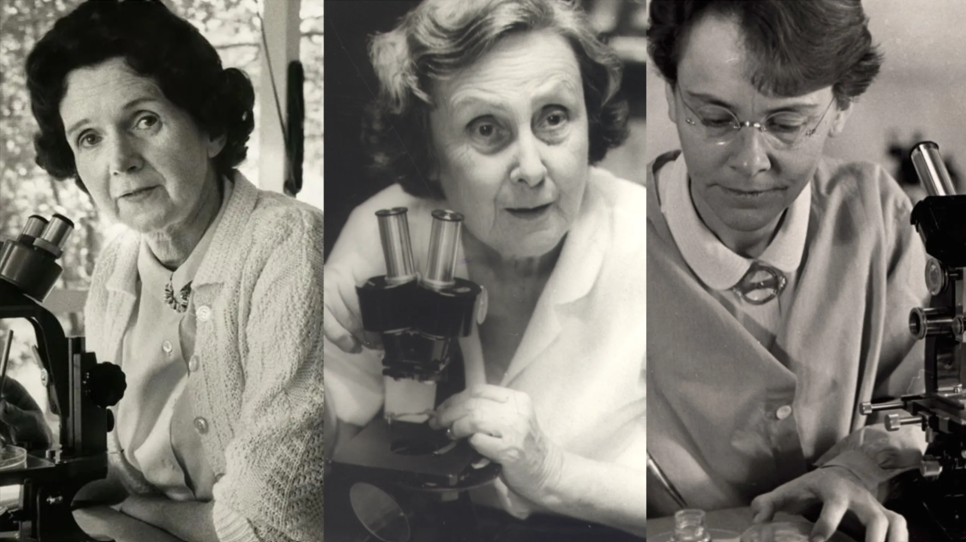
1- Photographer: Alfred Eisenstaedt | Source: National Portrait Gallery, Smithsonian Institution | Image: Rachel 2- Bertha in the laboratory | Source: National Archives, Correio da Manhã Collection. 3- Image: Johanna | Source: divulgencia.blogspot.com | Credit: Press Release.
The history of science is a testament to women who defied stereotypes and prejudices and overcame enormous obstacles in their careers. They made revolutionary discoveries, but to do so, they followed tortuous paths fraught with adversity. According to the UN Secretary-General, António Guterres, discrimination against women in science and technology is the result of centuries of patriarchy and false truths. Men are stronger, have ease with manual work, and possess more logical and agile reasoning. Women, on the other hand, are fragile, emotional, have more social skills, and are born with an unquestionable maternal instinct. They like blue, they like pink. How many times have you come across statements like this?
The myth of the fragile woman seems to be one of the most widespread. However, recent research has deconstructed and questioned these beliefs that only reinforce unequal patterns. A study conducted at Duke University in the United States reveals that, contrary to popular belief, women have survived up to four years longer than men during historical periods such as epidemics, famine, and slavery. During the COVID-19 pandemic, for example, 58% of deaths were among male patients. This makes me question: Why, then, is woman considered the weaker sex?
Another recently released study provides evidence challenging the historical stereotype of the man as hunter and the woman as homemaker. By analyzing data collected from 63 societies over the last 11,000 years, scientists concluded that in 79% of these societies, women also played the role of hunters. Furthermore, current research reveals that, in addition to being skilled hunters, women were the driving force behind one of humanity's greatest advancements: agriculture. As organic farmer Selene Hammer Tesch aptly points out,
“It was thanks to women's intelligence that it was discovered that some seeds sprouted and others were edible. From there came planting, harvesting, and abundance.”
The truth is that science, for many years, was mistaken about women. And we know why: when there are only men in science, it will reflect their interests and biases.
Today, women make up about 54% of doctoral students in Brazil, representing an impressive 10% increase in the last two decades. However, research conducted by the Multidisciplinary Affirmative Action Studies Group at UERJ shows that as women advance in their scientific careers, they find fewer and fewer other women walking alongside them. Female underrepresentation grows as positions gain more power. And even occupying similar positions, women earn, on average, 20% less than men.
“For most of history, ‘anonymous’ was a woman.” This quote is from the British writer Virginia Woolf. Motivated by her, I write this text with the aim of disseminating the names of women scientists and sowing the idea that science is a territory that belongs to us.
Rachel Carson was a marine biologist who denounced and warned the world about the dangers of pesticides in her book "Silent Spring," published in the 1960s. She had a profound impact on the environmental movement and provoked significant transformations in the environmental policy of the United States.
Another pioneer was Johanna Döbereiner. Nominated for the Nobel Prize and considered the scientist who revolutionized agriculture. In Brazil, she focused her studies on finding alternatives to the use of chemical fertilizers. The result? An annual savings of 2 billion dollars in soybean production alone, transforming Brazil into the second largest producer of this grain in the world. In addition, of course, to all the impact on the conservation of rivers and soil.
Bertha Lutz was another giant of a woman! A biologist, specialist, and passionate about frogs, her life was divided between feminism and science. Bertha was one of the first organizers of the feminist movement in Brazil, leading the fight for political equality and battling for the right of Brazilian women to vote and be elected. Her dedication to feminist causes inspired many other women scientists to get involved in politics and the fight for gender equality.

Scientists: Jaqueline Goes de Jesus and Ester Sabino | Source: Institute of Tropical Medicine, USP (University of São Paulo).
Ester Sabino and Jaqueline Goes de Jesus also made history by uncovering important information about the genetics of the Coronavirus, contributing to the fight against the Covid-19 pandemic.
In the medical field, Françoise Barré-Sinoussi made a crucial contribution to science and humanity at the end of the 20th century. She was one of the scientists responsible for identifying the HIV virus as the cause of AIDS, paving the way for the development of treatments against the disease, which are now advancing towards a cure.
And how can we not mention Nise da Silveira, a revolutionary! For her, science and creativity go hand in hand to illuminate the unknown. What is art for one, is a cure for another. It was from this thought that Nise fought for and transformed mental health treatments in Brazil.
In the humanities, Lélia González is one of the most important intellectuals and activists in our history! Considered the first Black woman to dedicate herself to the study of race and gender in Brazil, Lélia developed strong research and activism in the area. She was indispensable in reflecting on the role of Black women in Brazilian society.

1- Photo by U. Montan | Courtesy of The Nobel Foundation. 2- Nise on display at the Museum of Images of the Unconscious (1966) | Credit: CCBB Rio de Janeiro Press Office. 3- Lélia and the concept of Amefricanity focusing on the issue of the Black diaspora | Source: Reproduction.
Another scientist of great importance is Helena Theodoro: the first Black woman to earn a doctorate in philosophy and to treat samba as a science within the university. She is a major reference in research on Black culture, carnival, samba and art, African and Afro-Brazilian religious experiences, and race relations.
In the field of exact sciences, still underrepresented by women, the mathematician and writer Ada Byron was a pioneer in computer science in the 19th century. She wrote the first algorithm to be executed on a machine, laying the foundations for the digital revolution that would occur in the 20th century. Current studies on Artificial Intelligence still reference the work developed by Ada.
Another name, this one a little more well-known, is that of Marie Curie. Since 1901, only 3% of the people who have won the Nobel Prize in scientific categories have been women. Marie Curie made history as the first woman to receive a Nobel Prize and as the only person to win two Nobel Prizes in different fields: physics and chemistry. Her research on radioactivity opened new horizons in science. And another inspiring scientist: Elisa Frota Pessôa. She was one of the first women to graduate in Physics in Brazil, faced numerous adversities in choosing this career path, and played a fundamental role in the institutionalization of Physics in the country, being a co-founder of the Brazilian Center for Physics Research (CBPF).
And what unites all these women? A passion for science, above all, inspiring stories, and a desire for futures with more equality, opportunities, recognition, and more women in science!