
“FRUTUROS — AMAZONIAN TIMES” AT THE MUSEUM OF TOMORROW
17/12/2021
Author
Thematic Axis
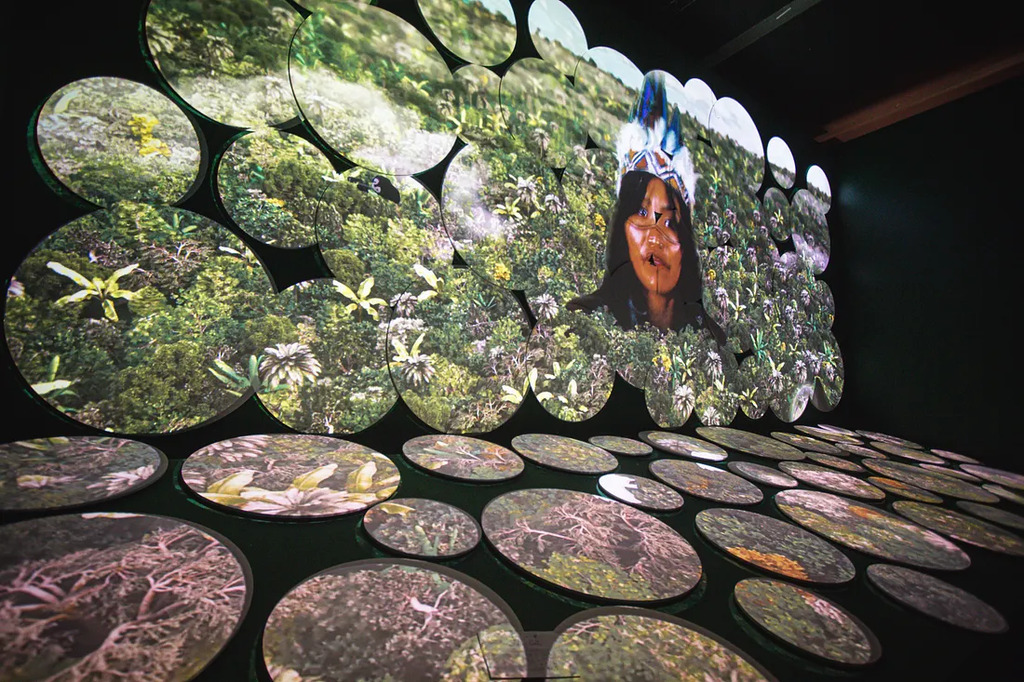
Fruturos Exhibition. Photograph: Albert Andrade.
In the largest tropical rainforest on the planet, life, microbiota, plants, fungi, animals, indigenous peoples, riverside communities, and other populations intertwine in a dynamic and imposing balance across a geography of mountains and plains, from the Andes to the mouth of the Amazon River and the Atlantic Ocean.
Globally, human history in recent centuries has achieved gigantic accomplishments, unimaginable until recently, such as the enormous reduction in infant mortality, a large increase in life expectancy, fantastic advances in science, health, the digital world, among others.
The achievements of civilization do not hide its failures. There are still a billion people in a situation of food insecurity, even with food available for everyone and much more. Inequality reaches abject levels. The feeling of disconnection from history and nature causes anxiety and alienation. Challenges are the path of humanity.
But in the 21st century, the long road has reached an unprecedented crossroads. In the short timeframe of humankind (not the long timeframe of the planet's nature), we have become very powerful, moving more matter than natural processes allow, capturing and transforming large portions of land, sunlight, and water to serve our interests. We have done so without any concern for nature's capacity to recover and continue to offer us climate, biodiversity, fertile soils, water, clean air, and the necessary conditions for the sustainability of life as we know it within our time horizon.
The dynamic equilibrium of the Holocene has been broken. We are beginning a new era, the Anthropocene, the age of humankind. If our steps on this new journey continue, arrogantly and ignorantly detached from the biosphere to which we belong, disrespecting the planet's limits, the future will be destructive for natural life and very dangerous for civilization. Who will we be? What will our era be like?
If our choices lead us to a more holistic and just vision of the meaning of human development, to humility before nature and its regeneration on the planet, we will still not know who we will be and what our time will be like, but the green of the forests and of hope will be present.
The Amazon now resides at the heart of humanity's crossroads. Ending deforestation and other forms of forest destruction has many fundamental meanings.
It means overcoming crime and corruption (always behind the destruction in the region) and building a more just and less violent democratic governance.
It means preserving biodiversity as a source of resources for the sustainable development of the region, of Brazil, and, above all, for the well-being of its populations.
It means guaranteeing the rainfall necessary for agriculture and the large cities of the Central-West and Southeast of Brazil.
It means, in the face of the threat of the Sixth Great Extinction of Life in the planet's natural history—this time, with our species as the cause—saying no to the Anthropocene as an age of death and to humanity as the executioner.
It means, in the face of the immense stock of CO2 released into the atmosphere due to deforestation, avoiding the great planetary catastrophe of the worst-case scenarios of global warming.
It means preserving the lives, cultures, and knowledge of indigenous peoples and traditional populations, with their magnificent contributions to humanity. And adding a mark of dignity to the history of Brazil, so scarred by two genocides and the consolidation of unacceptable inequality.
The Amazon was once thought of as the jungle to be conquered. In a beautiful paradox, in the Anthropocene, it is the jungle that we need to conquer us. The jungle (and science too) cries out that the whole will never be known, however long the journey, and that assuming this humility is civilizing. Indigenous peoples cry out that the threat is not the jungle, but the omnipotent, narcissistic, and impossible-to-civilize pretension that ignores the jungle.
All these dimensions of the choices we will make about the future of the Amazon are magnificently presented in the exhibition “Fruturos — Amazonian Times,” which opened today at the Museum of Tomorrow in Rio de Janeiro and will be on display until June 2022. Enjoy your visit, have good reflections, and reap the rewards of the Amazonian “fruturos.”