
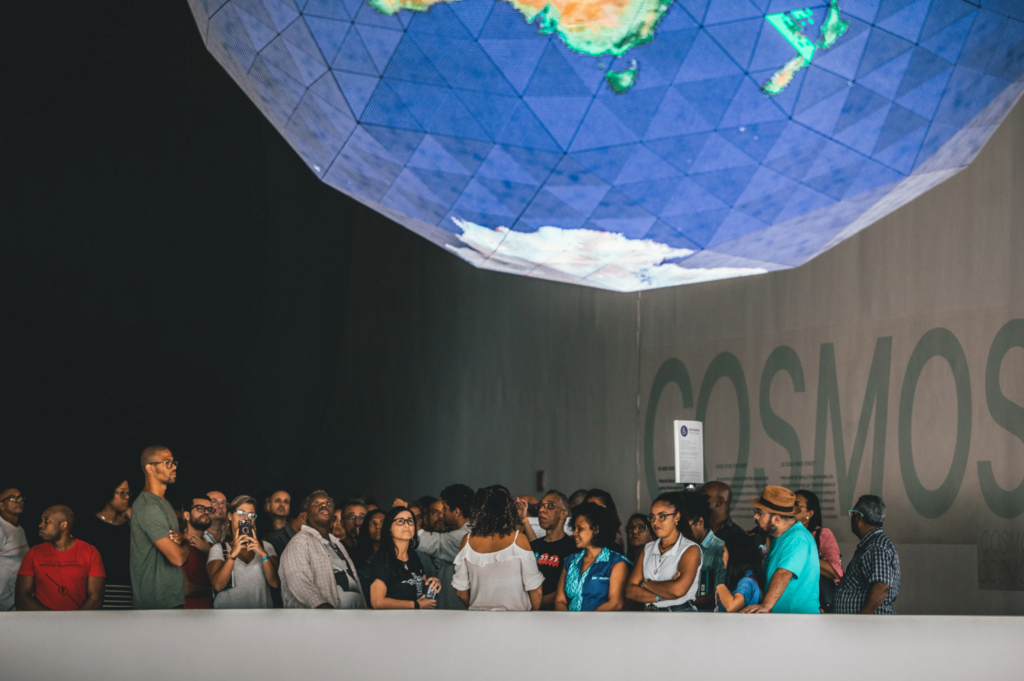
Visitors at Cosmos, in front of the Sphere. Photograph: Museum of Tomorrow.
In another step towards strengthening Brazilian science education, Inspira Ciência, a teacher training program for Basic Education carried out by the Museum of Tomorrow and the British Council with sponsorship from IBM, brings two major new developments: a new book and a website, which can be found at www.inspiraciencia.org.br.
“Our goal is to offer teachers tools to update their knowledge, find inspiration, and plan their lessons, improving teaching experiences and learning in Basic Education, a fundamental stage in the formation of current and future generations,” says Alfredo Tolmasquim, Director of Scientific Development at the Museum.
“Considering that the country has approximately fifty million students enrolled in Brazilian schools, whether children and adolescents of school age or young people and adults who have had the opportunity to return to the classroom, supporting the training of these teachers benefits the development of the country as a whole, be it Higher Education, the job market, and the direction of society more broadly,” explains Luis Serrao, Senior Manager of Basic Education at the British Council.
The book features articles on fundamental science topics, low-cost experiments, and lesson plans.
Organized around the units Universe and Solar System, Earth and Biosphere, Humanity and Culture, the new Inspira Ciência book contains articles written by university professors and researchers from various fields of knowledge. They cover topics ranging from the origin of the Universe, dark matter and dark energy, through the chronology of the Earth, the origin of life and the evolution of species, to human expansion across the planet and the impacts of the current economic development model on the environment in general, and Guanabara Bay in particular.
These articles are accompanied by step-by-step instructions for conducting three low-cost experiments to address these topics in a more dynamic and creative way. The first is a scale model of the Solar System, where the Sun is a basketball or soccer ball and the Earth is a peppercorn, allowing students to understand and calculate the dimensions and distances between the Sun and the planets. The second is a microscope made from cardboard cutouts, lenses from discarded DVDs, and a cell phone camera, allowing students to learn science in a hands-on way. The third is a sandbox, a sandbox connected to electronic sensors that creates a captivating and interactive visual experience for teaching geosciences.
The book also presents important approaches to science education, including deep learning, inquiry-based teaching, and encouraging girls to pursue scientific careers.
Website Facilitates Lesson Plan Development
In addition to the new book, Inspira Ciência also launched a website. On it, all teachers can access and use lesson plans produced by program participants, and also create their own plans, considering the themes and competencies recommended by the National Common Curriculum Base in this process.
Currently, 13 lesson plans developed by Inspira Ciência participants are available. Each month, more plans produced in the program and by teachers using the website to develop their lessons will be made available to the public. This is a way to consolidate the Inspira Ciência website and books as increasingly present work tools in the daily lives of basic education teachers.
“The combination of the website and the new Inspira Ciência book is an incentive to make science teaching even more in-depth, investigative, interdisciplinary, and creative in Brazilian schools,” explains Alfredo Tolmasquim. In turn, Luis Serrao believes that “another positive aspect of these new contents, which are the hallmark of Inspira Ciência, is showing how schools, museums, and universities can work together to strengthen the entire ecosystem of education and science.”